Archives April 2024

Electrostatics-10 Important basic MCQs (Quiz) Part 2

Electrostatics-10 Important basic MCQs (Quiz) Part 2

Electrostatics-10 Important basic MCQs (Quiz) Part 2

1.ABC is a right angled triangle in which AB= 3 cm  and BC = 4cm  . And \angle ABC\;=\frac{\mathrm\pi}2 . The three charges +15, +12    and  -20 e.s.u. are placed respectively on  A, B  and C . The force acting on B is 

(A) 125 dyne

(B) 35 dynes

 (C) 25 dynes

(D) Zero

2.Electric charges of 1\mu C, -1\mu C and 2\mu C  are placed in air at the corners A, B and C respectively of an equilateral triangle ABC having length of each side 10 cm. The resultant force on the charge at C is

(A) 0.9 N                       

(B) 1.8 N

(C) 2.7 N                       

(D) 3.6 N

3. Two charges placed in air repel each other by a force of 10^{-4} N . When oil is introduced between the charges, the force becomes 2.5\;\times\;10^{-5}\;N.The dielectric constant of oil is

(A) 2.5                         

B) 0.25

(C) 2.0                           

(D) 4.0

4. Two spherical conductors B and C having equal radii and carrying equal charges in them repel each other with a force F when kept apart at some distance. A third spherical conductor having same radius as that of B but uncharged is brought in contact with B, then brought in contact with C and finally removed away from both. The new force of repulsion between B and C is

 (A) F/4                         

(B) 3F/4

(C) F/8                

(D) 3F/8

5. The charges on two sphere are +7µC and –5µC They experience a force F. If each of them is given and additional charge of – 2µC, the new force of attraction will be

 (A) F                             

(B) F / 2

(C)  \frac F{\sqrt3}                 

(D) 2F

6. Electric lines of force about negative point charge are

(A) Circular, anticlockwise  

(B) Circular, clockwise

(C) Radial, inward

(D) Radial, outward

7. A charge q is placed at the centre of the line joining two equal charges  Q. The system of the three charges will be equilibrium, if  is equal to

(A) -\frac Q2                          

(B)-\frac Q4    

(C) +\frac Q4                             

(D) +\frac Q2    

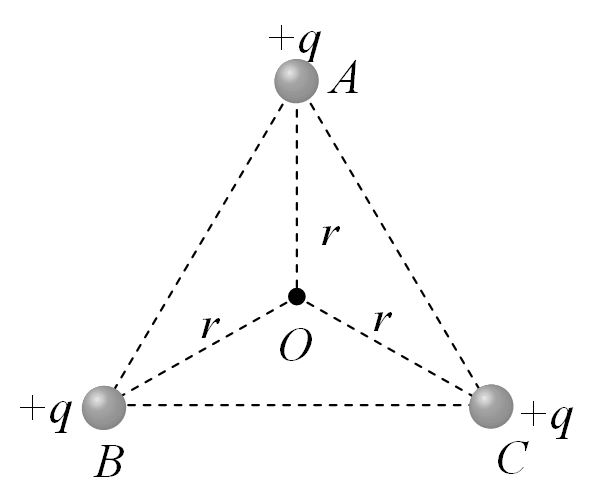
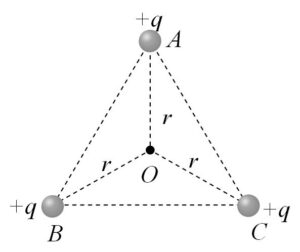
8. ABC is an equilateral triangle. Charges +q are placed at each corner. The electric intensity at O will be
Electrostatics-10 Important basic MCQs (Quiz) Part 2

 (A)\frac1{4\mathrm\pi\;\in_{\mathrm o}}\frac q{r^2}

(B)\frac1{4\mathrm\pi\;\in_{\mathrm o}}\frac{3q}{r^2}

(C) Zero

(D)\frac1{4\mathrm\pi\;\in_{\mathrm o}}\frac qr
9. The electric field inside a spherical shell of uniform surface charge density is

(A) Zero

(B) Constant, less than zero

(C) Directly proportional to the distance from the centre

 (D) None of the above

10.When a body is earth connected, electrons from the earth flow into the body. This means the body is…..

 (A) Unchanged

(B) Charged positively

(C) Charged negatively  

(D) An insulator

Electrostatics-10 Important basic MCQs (Quiz) Part 1

Electrostatics-10 Important basic MCQs (Quiz) Part 1

Electrostatics-10 Important basic MCQs (Quiz) Part 1

1.An isolated solid metallic sphere is given charge +Q.  The charge will be distributed on the sphere       

 (A) Uniformly but only on surface

(B) Only on surface but non-uniformly

(C) Uniformly inside the volume

(D) Non-uniformly inside the volume

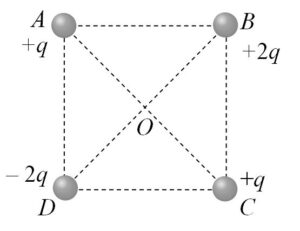
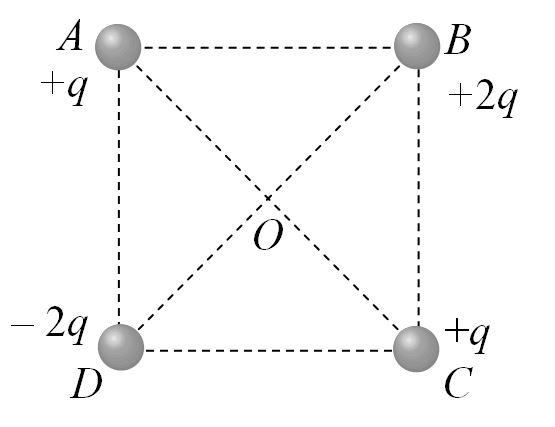
2. Four charges are arranged at the corners of a square ABCD, as shown in the adjoining figure. The force on the charge kept at the centre O is

Electrostatics-10 Important basic MCQs (Quiz) Part 1

(A) Zero

(B) Along the diagonal AC

(C) Along the diagonal BD

(D) Perpendicular to side AB

3.The ratio of the forces between two small spheres with constant charge in (a) air  (b) in a medium of dielectric constant K is
(A) 1 : K                        

(B) K : 1

(C) 1: K^2  

(D) K^2 : 1     

4. Three charges 4q , Q and q  are in a straight line in the position of 0, l/2,  and l respectively.   The resultant force on q will be zero, if  Q=

(A) – q                           

(B) – 2q

(C) -\frac q2 

(D)  4q

5.Two charges each of 1 coulomb are at a distance 1 km apart, the force between them is  

(A)     9\;\times\;10^3\;Newton\;         

(B) 9\;\times\;10^{-3}\;Newton\;  

(C) 1.1\;\times\;10^{-4}\;Newton\;

(D) 10^4\;Newton\;  

6. There are two metallic spheres of same radii but one is solid and the other is hollow, then

 (A) Solid sphere can be given more charge

 (B) Hollow sphere can be given more charge

(C) They can be charged equally (maximum)

(D) None of the above

7. Three equal charges are placed on the three corners of a square. If the force between q_1 and q_2 is F_{12}  and that between q_1  and q_3 is F_{13} , the ratio of magnitudes \frac{F_{12}}{F_{13}} is 

(A) \frac12                     

(B) 2 

(C)  \frac1{\sqrt2}\;

(D) \sqrt{2\;} 

8. Two small spheres each having the charge Q are suspended by insulating threads of length  from a hook. This arrangement is taken in space where there is no gravitational effect, then the angle between the two suspensions and the tension in each will be

(A) 180^o,\;\frac1{4\mathrm\pi\;\in_{\mathrm o}}\frac{Q^2}{{(2L)}^2}   

(B)   90^o,\;\frac1{4\mathrm\pi\;\in_{\mathrm o}}\frac{Q^2}{{L}^2}

(C)    180^o,\;\frac1{4\mathrm\pi\;\in_{\mathrm o}}\frac{Q^2}{2 L^2}           

(D)    180^o,\;\frac1{4\mathrm\pi\;\in_{\mathrm o}}\frac{Q^2}{  L^2}           

9. A soap bubble is given a negative charge, then its radius

(A) Decreases

(B) Increases

 (C) Remains unchanged

(D) Nothing can be predicted as information is insufficient

10. With the rise in temperature, the dielectric constant of a liquid

(A) Remains unchanged

(B) Changes erratically

(C) Increases                 

(D) Decreases


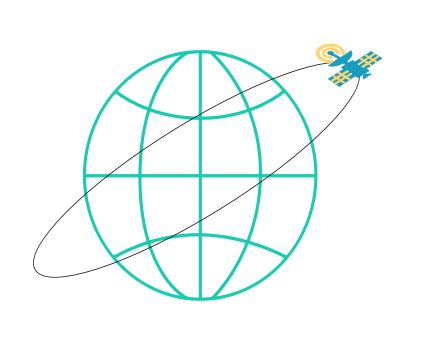
A spaceship is launched into a circular orbit close to the earth’s surface. What additional velocity has now to be imparted to the spaceship in the orbit to overcome the gravitational pull.

Additional velocity

Additional Velocity Required to Overcome Earth's Gravitational Pull for Satellite Escape

Escape velocity is the minimum velocity an object must attain to break free from the gravitational attraction of a massive body without further propulsion. For an object on the surface of the Earth, this velocity is approximately 11.2 kilometers per second (or about 25,000 miles per hour). But for a satellite already in orbit, the calculation is little more complex.

Satellites in low Earth orbit (LEO) typically travel at speeds around 8 kilometers per second (km/s). This velocity, known as orbital velocity, is necessary to counteract the gravitational force pulling the satellite towards Earth, allowing it to maintain a stable orbit.

However, what if we seek to free a satellite from Earth’s gravitational grasp altogether? Escaping Earth’s gravitational influence requires imparting additional velocity to the satellite. Suppose we have a satellite orbiting near the Earth’s surface, with an orbital velocity of approximately 8 km/s. To break free from Earth’s gravity, an additional velocity of approximately 3.2 km/s is needed.

Example

Q.A spaceship is launched into a circular orbit close to the earth's surface. What additional velocity has now to be imparted to the spaceship in the orbit to overcome the gravitational pull. Radius of earth =6400 km , g= 9.8 ms^{-2}

(A) 3.2 km/s

(B) 11.2 km/s

(C) 1.5 km/s

(D) 8 km/s

Solution

We know that , orbital speed of satellite is
v_o=\;\sqrt{\frac{GM}r}\;
where\;r\;is\;dis\tan ce\;from\;centre\;of\;planet/earth
Also, r= R+ h where R is radius of planet/earth and h is height of satellite from surface of earth
v_o=\;\sqrt{\frac{GM}{R+h}}\;
Near to earth's surface, h can be neglected
So, R\;+\;h\;\approx\;R
v_o=\;\sqrt{\frac{GM}{R}}\;
v_o=\;\sqrt{\frac{gR^2}{R}}\;
v_o=\;\sqrt{gR}\;
v_o\;=\;\sqrt{Rg}\approx\;8\;km/s\;
v_e\;=\;\sqrt{2Rg}\approx\;11.2\;km/s\;
Addition velocity required is
v_{add}\;=\;v_e\;\;-\;v_{o\;}
v_{add}\;=11.2 - 8 = 3.2 km/sec
(A) is correct option
Additional velocity

Conclusion

This additional velocity is crucial for overcoming the gravitational potential energy barrier that binds the satellite to Earth. When the satellite reaches this escape velocity, its kinetic energy surpasses the gravitational potential energy, allowing it to break away from orbit and venture into interplanetary space.