A block A (mass 4 kg) is placed on a smooth horizontal surface. Another block B (mass 2 kg) is placed on top of A. A horizontal force F is applied to block A as shown. The coefficient of static friction between the two blocks is μ = 0.25. Find the maximum value of force F such that both blocks move together without slipping.
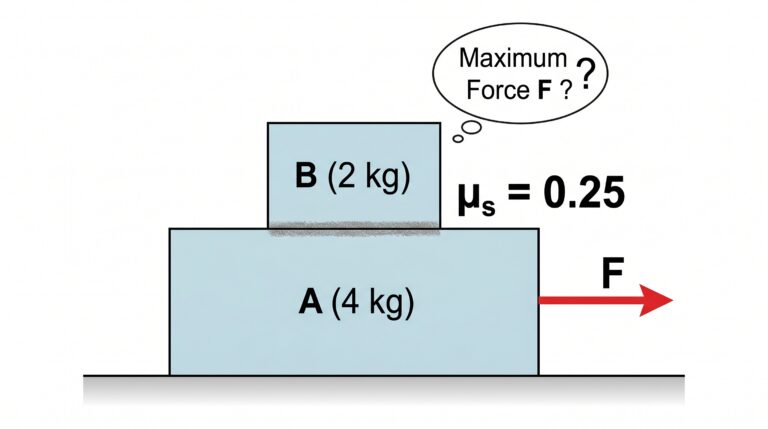
Complete Video Solution below
Maximum Force such that both blocks move together Without Slipping: Understanding the Real Physics
One of the most common friction problems in JEE Main, JEE Advanced, and NEET involves two blocks placed one above the other. A horizontal force is applied to the lower block, and students are asked to find the maximum force that can be applied so that both blocks move together without slipping.
At first glance, this may look like a standard formula-based problem. However, the real value of this question lies in the concepts it teaches.
In fact, many students solve such problems mechanically without understanding the actual role of friction. As a result, they often make mistakes when the problem is slightly modified.
Before jumping to equations, let us first understand the physics behind this situation.
The First Question: How Does the Upper Block Move?
Suppose a force is applied to the lower block.
The lower block is directly connected to the external force, so it is obvious why it starts moving.
But what about the upper block?
No force is directly applied to it.
So why should it move at all?
This is the most important question in the entire problem.
Before writing equations, always ask yourself:
What is the force responsible for accelerating the upper block?
Once you answer this question, the entire problem becomes much easier.
Many students immediately start looking for formulas.
A better approach is to first understand the physics.
Do not start with formulas. Start with physics.
The Hero of the Story: Static Friction
The upper block moves because of static friction.
Many students think friction only opposes motion.
This is not entirely true.
A more accurate statement is:
Friction opposes relative motion or the tendency of relative motion between two surfaces.
In this problem, the lower block tries to move forward. If there were no friction, the lower block would slide out from beneath the upper block.
Static friction prevents this from happening.
It pulls the upper block forward and allows both blocks to move together.
Therefore, static friction is not acting as an enemy here.
It is actually helping the upper block move.
This is a very important idea that students should remember.
Static Friction Is Smarter Than Most Students Think
Many students believe that static friction is always equal to μN.
This is one of the most common misconceptions in mechanics.
Static friction is not a fixed force.
It adjusts itself according to the requirement of the situation.
If a small friction force is needed, static friction provides a small force.
If a larger friction force is needed, static friction increases its value.
However, it cannot increase forever.
There is a maximum limit beyond which static friction cannot go.
As long as the required friction remains below this limit, the blocks continue to move together.
The moment the required friction exceeds this limit, slipping begins.
Understanding this single idea can solve a large number of friction problems.
Why Friction Direction Confuses Students
One of the most common mistakes in friction problems is assuming the wrong direction of friction.
Students often memorize rules instead of thinking physically.
The correct approach is simple.
Ask yourself:
If friction were absent, what would happen?
Without friction, the lower block would move forward while the upper block would tend to stay where it is because of inertia.
Therefore, relative to the lower block, the upper block would appear to move backward.
Static friction opposes this tendency.
As a result, friction acts forward on the upper block.
According to Newton’s Third Law, an equal and opposite friction force acts backward on the lower block.
The direction becomes obvious once you understand the physical situation.
A Common Mistake Students Make
Many students immediately draw friction opposite to the motion of the object.
This shortcut often creates confusion.
Remember:
Friction does not oppose motion. Friction opposes relative motion.
This small distinction can completely change the solution.
Whenever you are confused about friction direction, imagine the situation without friction.
The correct direction usually becomes obvious.
A small mistake here can spoil the entire problem.
As teachers often say:
A small mistake in friction direction can make the entire solution go wrong.
Moving Together Means No Slipping
The statement “both blocks move together” is extremely important.
It tells us that there is no relative motion between the two blocks.
Since there is no slipping, kinetic friction does not come into the picture.
Only static friction is acting.
Many students immediately use friction formulas without first identifying the type of friction involved.
This is dangerous.
Always determine whether slipping is occurring or not before choosing the friction model.
As long as the two blocks move together, static friction is responsible for maintaining the common motion.
Can Static Friction Do the Job?
Now we come to the central idea of the problem.
The upper block needs a certain force to accelerate along with the lower block.
That force is supplied by static friction.
However, static friction is not unlimited.
It has a maximum possible value.
As the applied force on the system increases, the acceleration of the system increases.
A larger acceleration means the upper block requires a larger friction force.
Initially, static friction can easily provide the required force.
But as the applied force keeps increasing, a stage is reached where the required friction becomes equal to the maximum friction available.
This is the limiting situation.
At this point, static friction is working at its highest possible value.
This condition determines the maximum force that can be applied while keeping both blocks together.
What Happens Beyond This Limit?
Suppose we increase the applied force even further.
Now the upper block requires more friction than static friction can provide.
But friction cannot exceed its maximum limit.
As a result, static friction fails to maintain common motion.
The upper block can no longer keep up with the lower block.
Relative motion begins.
Slipping starts.
The moment slipping starts, static friction disappears and kinetic friction takes over.
This is why the problem asks for the maximum force.
It is asking for the boundary between two situations:
Both blocks move together.
The upper block starts slipping.
Understanding this boundary is much more important than memorizing any formula.
Why This Problem Is More Important Than It Looks
At first glance, this appears to be a simple two-block friction problem.
However, the ideas used here appear again and again in mechanics.
The same concepts are used in:
Friction problems
Wedge problems
Pulley systems
Circular motion with friction
Advanced Newton’s Laws questions
The goal is not to remember an answer.
The goal is to understand how forces interact and how friction helps maintain common motion.
Once you understand the physics behind this question, many seemingly difficult problems become much easier.
Physics Is About Understanding, Not Memorization
Many students search for shortcuts and formulas.
However, formulas are only the final result of physical reasoning.
If you understand the role of friction, the direction of friction, and the condition for slipping, you can derive the result whenever required.
That is the real goal of learning physics.
The two-block friction problem teaches us something far more valuable than a numerical answer.
It teaches us how static friction helps two surfaces maintain common motion and how slipping begins when friction reaches its limit.
Once this concept becomes clear, many friction problems become surprisingly simple.
Remember:
Do not start with formulas. Start with physics.
When the physics is clear, the mathematics becomes easy.
Final Solution
Given:
m_A\;=\;4\;kg
m_B=2kg
\mu_s=0.25
Maximum static friction:
System acceleration at limiting condition:
a_{max\;=\;\mu_s\;\;g}
a_{max\;=\;0.25\times\;\;10}
a_{max}=\;2.5\;m/s^2
For the complete system:
Fmax=(mA+mB)amaxF_{max}=(m_A+m_B)a_{max}Fmax=(mA+mB)amax Fmax=6×2.5=15 NF_{max}=6\times2.5=15\,NFmax=6×2.5=15N
Answer: Fmax=15NF_{max}=15NFmax=15N