10 Important Problems for IIT-JEE and NEET

10 Important Problems for IIT-JEE and NEET

Problems 1 of "10 Important Problems for IIT-JEE and NEET"

Q1.A solid disc is rolling without slipping on a horizontal ground as shown in figure. Its total kinetic energy is 150 J . Its translational and rotational kinetic energies respectively are

(A) 50 J , 100 J

(B)100 J , 50J

(C) 75 J, 75J

(D) 125J , 25J
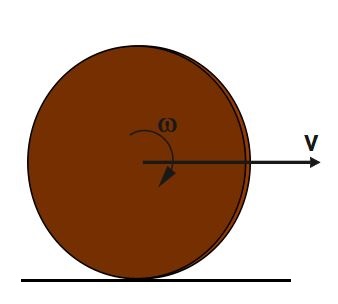
Rolling of a solid disc on horizontal and its K.E. energies Mechanics 10 Important Problems for IIT-JEE and NEET

Solution

As we know that, for pure rolling(without slipping) v=\;R\omega
Rolling of a solid disc on horizontal and its K.E. energies Mechanics 10 Important Problems for IIT-JEE and NEET
\frac{K.E._R}{K.E_T}=\frac{{\displaystyle\frac12}I\;\omega^2}{{\displaystyle\frac12}m\;v^2}
\frac{K.E._R}{K.E_T}=\;\frac{\displaystyle\frac12\left(mK^2\right)\;\omega^2}{\displaystyle\frac12m\;v^2}
\frac{K.E._R}{K.E_T} =\frac{\displaystyle K^2\;\omega^2}{\displaystyle v^2}
\frac{K.E._R}{K.E_T}=\frac{\displaystyle K^2\;\omega^2}{\displaystyle{(R\omega)}^2}=\frac{\displaystyle K^2\;\omega^2}{\displaystyle R^2\;\omega^2}
\frac{K.E._R}{K.E_T}=\frac{\displaystyle K^2\;}{\displaystyle R^2\;}.......(1)
Now, I=\;\frac12m\;R^2=m\;K^2\; where\; K \;is \;radius\; of\; Gyration
\Rightarrow\frac{K^2}{R^2}=\frac12.......(2)
\Rightarrow\;\frac{K.E._R}{K.E_T}=\frac{K^2}{R^2}=\frac12 [from (1) and (2)]
\Rightarrow\;\frac{K.E._R}{K.E_T}=\frac12
\Rightarrow\ K.E_T=\;\left(\frac2{1+2}\right)\;K.E._{total}
\Rightarrow\ K.E_T=\;\left(\frac2{3}\right)\;*150
\Rightarrow\ K.E_T= 2* 50 = 100J
Similarly, K.E_R=\;\left(\frac1{1+2}\right)\;K.E._{total}
\Rightarrow K.E_R=\;\left(\frac1{1+2}\right)\;*150
\Rightarrow K.E_R=\;\left(\frac1{3}\right)\;*150
\Rightarrow K.E_R=1*50=50J
(B) is correct option

Problems 2 of "10 Important Problems for IIT-JEE and NEET"

Q2.For given system of two blocks, find the maximum value of force F which can be applied on the system as shown in figure so that both blocks move together. [Given coefficient of static friction between both blocks = 0.3]

(A) 3N

(B) 6N

(C) 9N

(D) 12N
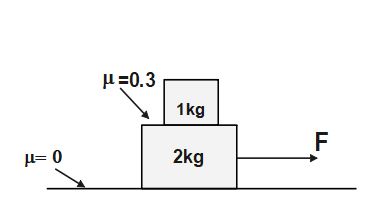
static friction to move two blocks together for IIT-JEE and NEET

Solution

Free body diagram of block of upper block is

For given system of two blocks, find the maximum value of force F which can be applied on the system as shown in figure so that both blocks move together. [Given coefficient of static friction between both blocks = 0.3]
We can see that the block 1 Kg (upper block) is moved by friction force. If block moves together (without slipping) it means the frictional force is static friction. Therefore,
f_{s,max}=\;\mu_sN
f_{s,max}=\;\mu_s mg
f_{s,max}=\;\ 0.3 * 1 * 10 = 3N
Thus, maximum acceleration that can be produced in upper block without slipping is
a_{max}=\frac{f_{s,max}}m=\;\frac31=3ms^{-2}
For system of blocks , to move together the maxmium force can be
F_{max}=\;M_{sys,net\;}\ast\;\;a_{max}
F_{max}=(1+2) * 3= 9N
(C) is correct option

Problems 3 of "10 Important Problems for IIT-JEE and NEET"

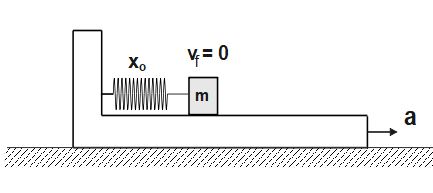
Q3.What is the maximum compression in the spring, if the lower block is shifted to rightward with acceleration a. (Given that all surfaces are smooth as shown).
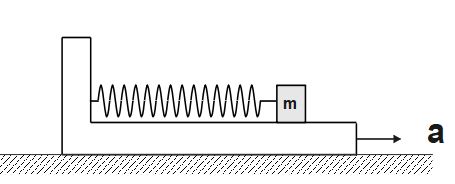
What is the maximum compression in the spring, if the lower block is shifted to rightward with acceleration a. (Given that all surfaces are smooth as shown).

(A) \frac{ma}k

(B) \frac{2ma}k

(C) \frac{mak}2

(D) \frac{ma}{2k}

Solution

Let us assume that the upper block of mass 'm' displaces by distance 'x' towards leftward with velocity 'v' (w.r.t to lower block) when lower block is shifted towards rightward with acceleration a.

We can solve this problem by two method (1) Force Method (2) Energy Method from non-inertial frame of refence (Lower plank/block) .

Force Method
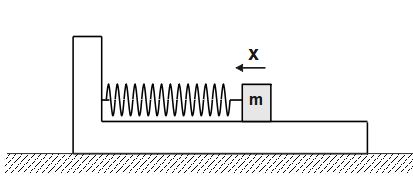
Acc. to Newton's 2nd law of motion,
F_{net}=F_{pseu}-F_{spring}
F_{net}=ma- kx
\frac{\operatorname dv}{\operatorname dt}=ma\;-\;kx
v\frac{\operatorname dv}{\operatorname dx}=ma\;-\;kx
v\;dv=\left(ma\;-\;kx\right)\;dx
Integrating both sides
\int_{v_i}^{v_f}\;vdv=\int_{x_i}^{x_f}\left(ma\;-\;kx\right)\;dx
\int_{0}^{0}\;vdv=\int_{0}^{x_o}\left(ma\;-\;kx\right)\;dx
\left[\frac{v^2}2\right]_0^0=\;ma\;\left[x\right]_0^{x_0}-k\left[\frac{x^2}2\right]_0^{x_o}
0-0=\;ma\;\left(x_o-0\right)-\;\frac12k\;\left(x_o^2-0\right)
0=\;ma x_o - \;\frac12k\ x_o^2
ma x_o = \frac12k\ x_o^2
2ma= k x_{o}
x_o=\frac{2ma}k
(B) is correct option
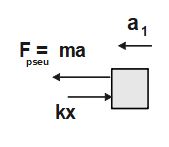
let a_1 be the acceleration of upper block w.r.t the lower block
FBD of upper block from lower block reference frame
Q3.What is the maximum compression in the spring, if the lower block is shifted to rightward with acceleration a. (Given that all surfaces are smooth as shown).
Boundary conditions for integration:
What is the maximum compression in the spring, if the lower block is shifted to rightward with acceleration a. (Given that all surfaces are smooth as shown).
Initially, the upper block is at rest when x=0, therefore v_{i}=0
When the spring has maximum compression x_{o}, again the block becomes stationary w.r.t. lower block.
So, v_{f}=0 , when x=x_{o}

Alternate Method

We can also solve this problem by Energy Method from non-inertial frame of refence (Lower plank/block) . We will apply Work-Energy theorem from lower block frame of reference.

Energy Method

We can apply Work-Energy theorem for initial and final position of upper block w.r.t. lower block
What is the maximum compression in the spring, if the lower block is shifted to rightward with acceleration a. (Given that all surfaces are smooth as shown).
Since, at initial position the upper block is at rest, therefore v_{i}=0
When the spring has maximum compression x_{o}, again the block becomes stationary w.r.t. lower block. So, also v_{f}=0
Acc. to Work-Energy Theorem,
F_{net}=ma- kx
W.D_{net \;by\;all\;forces}\;=\triangle K.E.\;
W.D._{pseudo}\;\;+\;W.D._{spring}\;=\;\frac12m\;v_f^2-\frac12m\;v_i^2
W.D._{pseudo}\;\;+\;W.D._{spring}\;=\;\frac12m\;*0^2-\frac12m\;*0^2
\Rightarrow\;ma\;x_o-\;\frac12k\;x_o^2=0
\Rightarrow\;ma\;x_o=\;\frac12k\;x_o^2
\Rightarrow\;ma\;=\;\frac12k\;x_o
\Rightarrow\;x_o=\frac{2ma}k
(B) is correct option
\;W.D._{cons}\;=-\triangle U
\;\Rightarrow\;W.D._{spring}\;=-\triangle U
\;\Rightarrow W.D._{spring}\;=-\;\frac12k\;x_{o}^2
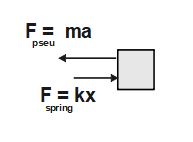
And, W.D._{pseu}={\overrightarrow{F\;}}_{pseu}.\overrightarrow{x_o}
\Rightarrow W.D._{pseu}=F_{pseu}\;x_{o\;}\cos0^o
\Rightarrow W.D._{pseu}=ma\;x_{o\;}

Problems 4 of "10 Important Problems for IIT-JEE and NEET"

Q4. A spaceship is launched into a circular orbit close to the earth's surface. What additional velocity has now to be imparted to the spaceship in the orbit to overcome the gravitational pull. Radius of earth =6400 km , g= 9.8 ms^{-2}

(A) 3.2 km/s

(B) 11.2 km/s

(C) 1.5 km/s

(D) 8 km/s

Solution

As we know that the speed of the spaceship in a circular orbit close to the earth's surface , v_o=\;\sqrt{gR}

Ans also, escape speed from earth's surface , v_e=\;\sqrt{2gR}

Additional velocity required to make spaceship escape,

v_{additional}= v_{e}- v_o= \;\sqrt{2gR}-\sqrt{gR}=\left(\sqrt2-1\right)\;\sqrt{gR}

v_{additional}=0.414 * 7.9= 3.27 km/s

(A) is correct option

Problems 5 of "10 Important Problems for IIT-JEE and NEET"

Q5. Moment of inertia of a uniform rod of length L and mass M, about an axis passing through L/3 from one end and perpendicular to its length is

(A) \frac2{27}M\;L^2

(B) \frac1{6}M\;L^2

(C) \frac1{12}M\;L^2

(D) \frac19M\;L^2

Solution
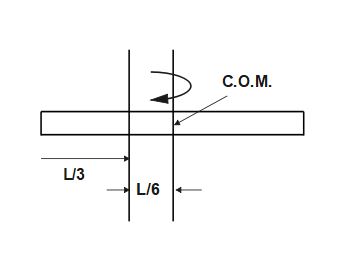
According to Parallel axis theorem ,
I_{parallel\;\;}=\;I_{COM}\;+\;M_{total\;}\;d^2
Here, d= perpendicular distance of parallel axis from the axis passing through C.O.M.
\;I_{COM}\; = Moment of Inertia of rod passing through C.O.M. (perpendicular to rod)
\Rightarrow\;I_{parallel}=\frac1{12}M\;L^2+\;M\;\left(\frac L6\right)^2
\Rightarrow\;I_{parallel}=\;ML^2\;\left[\frac1{12}+\frac1{36}\right]
\Rightarrow\;I_{parallel}=\frac19M\;L^2
(D) is correct option
We have , I_{com}=\frac1{12}ML^2
And \;total\;mass\;of\;rod,\;M_{total}=M
d=\frac L2-\frac L3=\frac L6

Problems 6 of "10 Important Problems for IIT-JEE and NEET"

Q6.F-x equation of a body of mass 4 kg in S.H.M. is F+\;16x\;=0

Here, F is newton and x in meter. The time period of oscillations will be

(A) 6.28\; sec

(B) 3.14\; sec

(C) 1.57\; sec

(D) 1 \; sec

Solution

Given that, F+\;16x\;=0
Also, m= 4kg
F=\;-16x .......(1)
On comparing (1) and (2)
-kx= -16x
\Rightarrow\; k= 16
Time period of S.H.M. is T=2\pi\sqrt{\frac mk}
\Rightarrow T=2\pi\sqrt{\frac4{16}}
\Rightarrow T=2\pi\sqrt{\frac14}
\Rightarrow T=\frac{2\pi}2=\pi
\Rightarrow T=\pi=\;3.14\;sec
(B) is correct option
We already know, the equation of S.H.M. can be written as
F = -kx ......(2)

Problems 7 of "10 Important Problems for IIT-JEE and NEET"

Q7.A ball of mass m moving at a sped v makes a head on collision with an identical ball at rest. If the kinetic energy of the balls after collision is \frac34th of the original. Then the coefficient of restitution is

(A) e=\frac1{\sqrt2}

(B) e=\frac12

(C) e=\frac{\sqrt2}3

(D) e=\frac13

Solution

Given that, mass of each ball = m
According to law of conservation of momentum
m_1 u_1 +m_2 u_2 = m_1 v_1 + m_2 v_2
m v +m *0 = m v_1 + m v_2
m v = m (v_1 + v_2)
v = (v_1 + v_2)
v_1 + v_2 = v.....(1)
Given that , K.E._{net,f\;}=\frac34K.E._{net,i\;}
Therefore, \frac12\;m_1\;v_1^2\;+\;\frac12\;m_2\;v_2^2\;=\;\frac34\left[\frac12\;m_1\;u_1^2\;+\;\frac12\;m_2\;u_2^2\;\right]
\frac12\;m\;\left(\frac{v(1-e)}2\right)^2\;+\;\frac12\;m\;\left(\frac{v(1+e)}2\right)^2\;=\;\frac34\left[\frac12\;m\;v^2\;+\;\frac12\;m\;{\ast\;0}^2\;\right]
\frac12\;\;\frac{v^2\;\left(1+e\right)^2}4\;+\;\frac12\;\;\frac{v^2\;\left(1-e\right)^2}4\;=\;\frac34\left(\frac12\;v^2\;\right)
\Rightarrow\left(1+e\right)^2+\left(1-e\right)^2=3
\Rightarrow1+\;e^2+\;2e\;+\;1\;+\;e^2-2e\;= 3
\Rightarrow\;2\;e^2=\;1
\Rightarrow\;e^2=\;\frac12
\Rightarrow\;e=\;\frac1{\sqrt2}
(A) is correct option
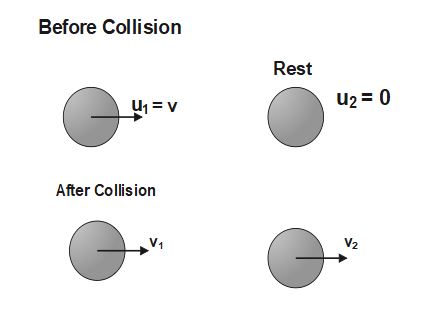
head on collision in mechanics
The formula of coefficient of restitution is :
e=\;\frac{vel. of sepration}{vel. of approach}
e=\;\frac{v_2-v_1}{u_1-u_2}
e=\;\frac{v_2-v_1}{v-0}
v_2- v_1= ev ....(2)
On adding (1) and (2), we get
2 v_2 = v +ev
v_2=\;\frac{v(1+e)}2
On subtracting (2) from (1), we get
2 v_1 = v - ev
v_1=\;\frac{v(1-e)}2

Problems 8 of "10 Important Problems for IIT-JEE and NEET"

Q8.The density of a rod AB increases linearly from A to B. Its mid-point is O and centre of mass is at C. Four axes pass through A, B, O and C , all perpendicular to the length of rod. The moments of inertia of the rod about these axes are I_{A}, I_{B}, I_{O} and I_{C} respectively. Then

(A) I_{A}> I_{B}

(B) I_{C} < I_{B}

(C) I_{O}> I_{C}

(D) All of these

Solution

Problems 9 of "10 Important Problems for IIT-JEE and NEET"

Q9.A simple harmonic oscillation has an amplitude A and time period T. The time required to travel from x=A\;to\;x=\frac A2 is

(A) \frac T4

(B) \frac T5

(C) \frac T6

(D) \frac T{12}

Solution

Problems 10 of "10 Important Problems for IIT-JEE and NEET"

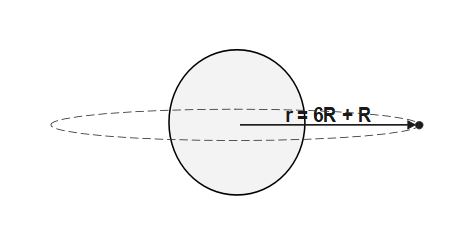
Q10. A geostationary satellite is orbiting the earth at a height of 6R above the surface of earth where R is the radius of earth. The time period of another satellite at a distance of 3.5 R from the centre of earth is

(A) 16.96 hours

(B) 8.48 hours

(C) 9.25 hours

(D) 15.76 hours

Solution

We know that , orbital speed of satellite is
v_o=\;\sqrt{\frac{GM}r}\;
where\;r\;is\;dis\tan ce\;from\;centre\;of\;planet/earth
T\;=\frac{dis\tan ce\;}{speed}=\;\frac{2\pi\;r}{v_o}
T\;=\;\frac{2\pi\;r}{\sqrt{\displaystyle\frac{GM}r}}
T\;=\;2\pi\;\sqrt{\frac{r^3}{GM}}
T\;=\;2\pi\;\sqrt{\frac{r^3}{GM}}\\T^2=\;4\;\pi^2\;\frac{r^3}{GM}
\Rightarrow T^2\;\;\propto\;r^3
This is known as Kepler's Law of period for planetary motion
r= R+ h where R is radius of planet/earth and h is height of satellite from surface of earth
\Rightarrow r_1 = R+ 6R=7R \;and \;r_2= 3.5R
\Rightarrow T\;\propto\;r^\frac32
\frac{T_2}{T_1}=\;\left(\frac{r_2}{r_1}\right)^\frac32
\frac{T_2}{T_1}=\;\left(\frac{3.5R}{7R}\right)^\frac32
\frac{T_2}{T_1}=\;\left(\frac{1}{2}\right)^\frac32
\frac{T_2}{T_1}=\frac1{2\sqrt2}
T_2 =T_1 * \frac1{2\sqrt2}
T_2 =24 * \frac1{2\sqrt2}
T_2 =12* \frac1{\sqrt2}
T_2 =12* 0.707= 8.48 \;hours
(B) is correct option

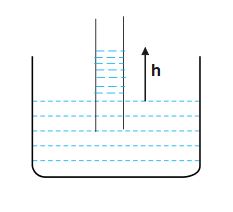
A capillary tube of radius r is immersed in water and water rises in it to a height h . The mass of water in the capillary tube is 4g . Another capillary tube of radius 2 r is immersed in water. The mass of water that will rise in this tube is:

A capillary tube of radius r is immersed in water and water rises in it to a height h. The mass of water in the capillary tube is 4g. Another capillary tube of radius 2r is immersed in water. The mass of water that will rise in this tube is:

A capillary tube of radius r is immersed in water and water rises in it to a height h. The mass of water in the capillary tube is 4g. Another capillary tube of radius 2r is immersed in water. The mass of water that will rise in this tube is:

(A) 2g

(B) 2.5g

(C) 8g

(D) 16g

Solution

h=\frac{2T\;\cos\theta}{\rho rg}

h=\frac{2T\;\cos\theta}{\left({\displaystyle\frac mV}\right)rg}

h=\frac{2T\;V\:\cos\theta}{mrg}

h=\frac{2T\;\left(\pi\;r^2\;h\right)\;\cos\theta}{mrg}

1 =\frac{2T\;\left(\pi\;r\;\right)\;\cos\theta}{m\;g}

m=\left(\frac{2\pi T\cos\theta}g\right)\;r

m\;\propto\;r

\frac{m_1}{m_2}=\frac{r_1}{r_2}

\frac{4}{m_2}=\frac{r}{2r}

m_2=\;\left(\frac{2r}r\right)\ast\;4

\Rightarrow m_2=\;2\ast\;4=8\;

\Rightarrow m_2=8g\;

(C) option is correct

A capillary tube of radius r is immersed in water and water rises in it to a height h. The mass of water in the capillary tube is 4g. Another capillary tube of radius 2r is immersed in water. The mass of water that will rise in this tube is:

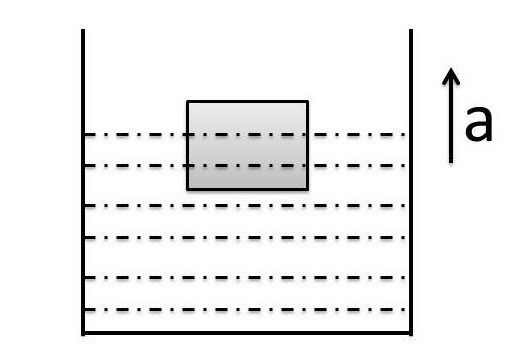
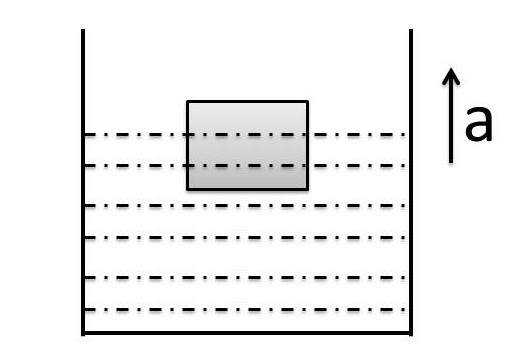
A partially immersed solid block of density [latex]\rho_s[/latex] is floating in a liquid of density [latex]\rho_L[/latex] as shown in figure. If beaker container moves up with positive acceleration ‘a’ , what is correct statement about the block?

Top 5 Fluid Mechanics problems for IIT-JEE NEET

Q.A partially immersed solid block of density \rho_s is floating in a liquid of density \rho_L as shown in figure. If beaker container moves up with positive acceleration 'a' , what is correct statement about the block ?

(A) It sinks more

(B) It sinks lesser

(C) It neither sinks more nor lesser

(D) Cannot be predicted as data is insufficient

Q2.A partially immersed solid block of <span class="wp-katex-eq" data-display="false">\rho_s</span> is floating in a liquid of density <span class="wp-katex-eq" data-display="false">\rho_L</span> as shown in figure. If beaker container moves up with positive acceleration &apos;a&apos; , what is correct statement about the block ?

Solution

Let V_{in} = Volume of block immersed in the liquid

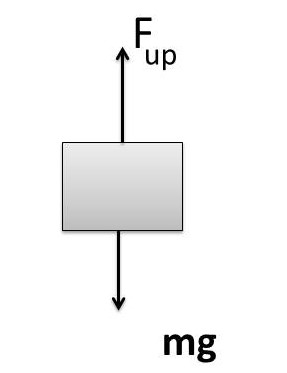
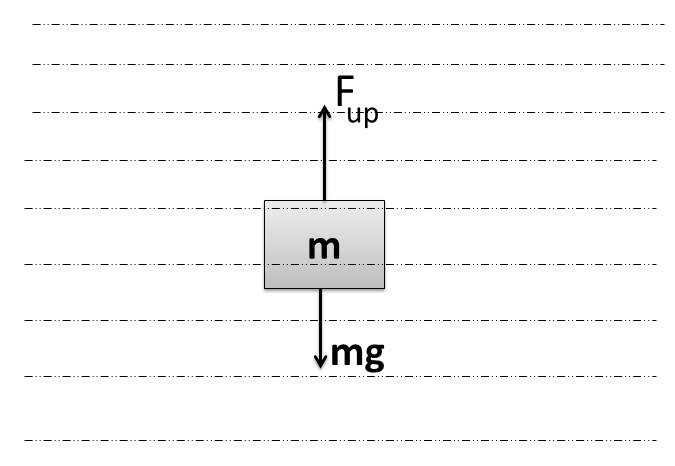
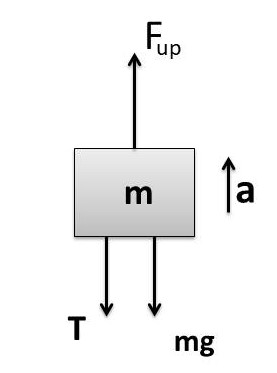
For Equilibrium of rest, see FBD as shown aside

F_{up}=V_{in}\;\rho_Lg\;=\;mg

V_{in}\;\rho_Lg\;=\;V\;\rho_S\;g\;

\;\frac{V_{in}}V\;=\frac{\rho_S}{\rho_L}

Therefore, fraction of volume inside the liquid is-

\;\frac{V_{in}}V\;=\frac{\rho_S}{\rho_L}.....(1)

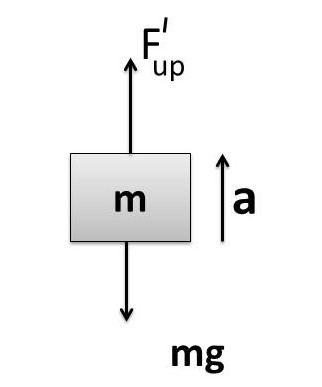
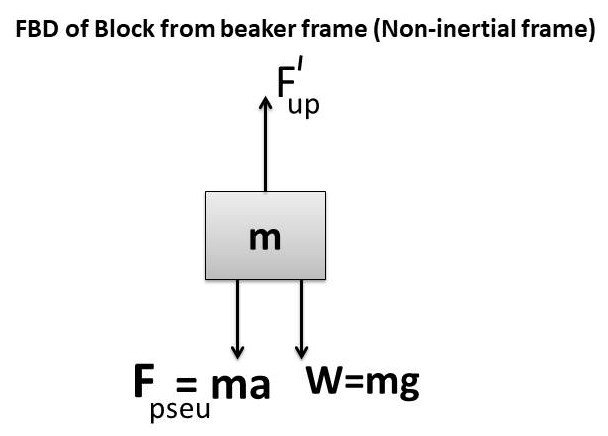
When block is moving up , the FBD is shown in figure

\;\\F_{up}^I=V_{in}^I\;\rho_L\;g_{eff}\\

F_{up}^I=V_{in}^I\;\rho_L\;(g+a).....(2)

F_{net}=F_{up}^I-mg
ma =F_{up}^I-mg
F_{up}^I=m(g+a)

F_{up}^I=V\;\rho_S\;(g+a)\\....(3)

From (2) and (3), V_{in}^I\;\rho_L\;(g+a)=V\;\rho_S\;(g+a)

\;\frac{V_{in}^I}V\;=\frac{\rho_S}{\rho_L}

\;\frac{V_{in}}V\;=\frac{\rho_S}{\rho_L}=\;\frac{V_{in}^I}V\;

Hence, fraction of volume immersed is again equal to \frac{\rho_S}{\rho_L}. It means immersed volume remains same .

Ans. (C) is correct option

Top 5 Fluid Mechanics problems for IIT-JEE NEET

Actually, this question is all about the Archimedes Principle which focus on the concept of Upthrust/Buoyant force acting on completely or partially immersed solid block or any other solid/hollow object. It helps in calculating the loss of weight when any solid substance is partially or completely immersed into the liquid. The liquid container may be stationary or moving with constant velocity/ variable velocity.

When completely or partially immersed solid block lies in stationary beaker container :- 

When beaker container is stationary then , according to Archimedes Principle , it loses its weight to equal to the weight of liquid displaced by the object (like completely or partially immersed solid block) . Therefore,

F_{up}=V_{in}\;\rho_Lg\;=\;mg

When completely or partially immersed solid block lies in beaker container moving up with constant acceleration :- 

When beaker container is moving up with uniform acceleration, then the loss of weight of object is now equal to apparent weight of liquid displaced by it.Thus, buoyant force/ upthrust changes so as to balance the increased effective weight of solid block when it observed from frame of reference of accelerated beaker. 

Top 5 Fluid Mechanics problems for IIT-JEE NEET

F_{up}^I=F_{pseu}+W

F_{up}^I=ma\;+\;mg

F_{up}^I=m(g\;+\;a)

F_{up}^I=mg_{eff} where g_{eff}=g+a

Therefore, we can write

\;\\F_{up}^I=V_{in}\;\rho_L\;g_{eff}\\

F_{up}^I=V_{in}\;\rho_L\;(g+a)

Conclusion-

From the above discussion, we understand that the volume immersed does not change when the container accelerates uniformly upwards or downwards along vertical. Immersed part remains same. Block neither sinks more nor lesser. This problems is best combine of Newton’s laws of motion, Archimedes’s Principle and Law of Flotation. This is how we reach to the conclusion that the knowledge of Free Body Diagram and Pseudo force  is necessary to get into problems solving process. In fact the basic idea of pseudo force can be summarized into one line that a problem which is solved by application Newton’s 2nd law (from ground frame) gets converted into problem of Equilibrium of rest (from non-inertial frame of reference)  by introducing concept of pseudo force. 
Pseudo force can be written as:

{\overrightarrow{F\;\;}}_{pseu}=-M_{object}\;\;{\overrightarrow{a\;\;}}_{frame}
The negative sign shows that the peudo force is taken opposite to direction of acceleration of non-inertial frame.
Law of flotation simply gives us the condition under which an object floats partially or completely immersed inside the liquid. It suggest that
(i) if the density of solid is lesser than  density of liquid then it floats partially immersed in the liquid
(ii) if the density of solid is equal to the density of liquid then it floats completely immersed in the liquid
(iii) if the density of solid is more than the density of liquid then it sinks completely unitl it settles down to bottom of container.
It is very interesting to note that this law also helps to find out fraction of immersed volume of object inside the liquid. We have to understand the relationships between different concepts of mechanics to solve such type of fluid mechanics problems.

Top 5 Fluid Mechanics problems for IIT-JEE NEET

Top 5 Fluid Mechanics problems for IIT-JEE NEET

Top 5 Fluid Mechanics problems for IIT-JEE NEET

Q1. from "Top 5 Fluid Mechanics problems for IIT-JEE NEET"

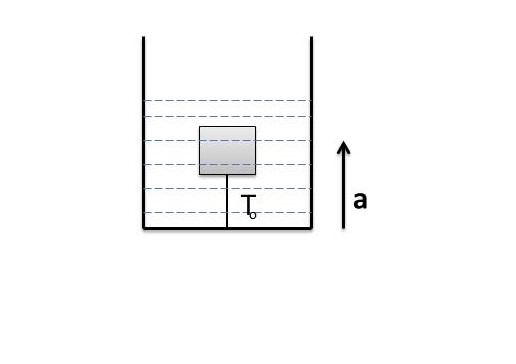
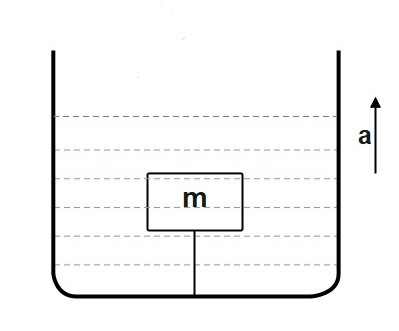
Q1.The tension in a string holding a solid block below the surface of a liquid (of density greater than that of solid) as shown in the figure is T_o when the system is at rest. What will be the tension in the string if the system has upward acceleration a.

Top 5 Fluid Mechanics problems for IIT-JEE NEET CBSE
Choose correct options among the following options.

Q1.The tension in a string holding a solid block below the surface of a liquid (of density greater than that of solid) as shown in the figure is T_o (To) when the system is at rest. What will be the tension in the string if the system has upward acceleration a.

(A) T_o\frac ag

(B) T_o\left(1-\frac ag\right)

(C) T_o\left(1+\frac ag\right)

(D) T_o\left(\frac ag-1\right)

Top 5 Fluid Mechanics problems for IIT-JEE NEET CBSE

Solution

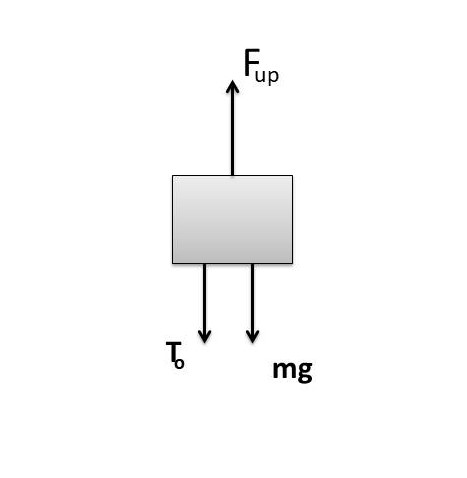
At Equilibrium (Rest), Free body diagram of block

Fluid Mechanics block fbd
T_0+mg=F_{up}
T_o+V\rho_Sg=\;\;V\rho_Lg\\
Vg(\;\rho_L-\;\rho_S)\;=T_o
\rho_L-\;\rho_S=\frac{T_o}{Vg}\;-----(1)

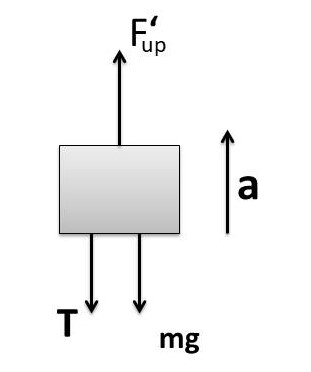
Free body diagram of block when it moves upwards.

fluid Mechanics upthrust FBD

When system moves up with acceleration 'a' then effective weight of fluid displaced also changes which is called apparent weight (of fluid displaced).

F_{up}^I=V\;\rho_L\;g_{eff}

Since, the system is moving up with acceleration 'a' .Thus, \\g_{eff}=\;g+a-----(2)

As 'a' be the acceleration of system , Use Free body diagram of the moving block

F_{net}=F_{up}^I-mg-T

Therefore, ma=V\;\rho_L\;g_{eff}-mg-T

m(\;a\;+g)=V\;\rho_L\;g_{eff}\;-T

V\;\rho_S\;(\;a\;+g)=V\;\rho_L\;g_{eff}\;-T

Now use (2), V\;\rho_S\;(\;g+a)=V\;\rho_L\;(g+a)\;-T

V\;\rho_S\;(\;g+a)=V\;\rho_L\;(g+a)\;-T

T=\;V(g+a)\;(\;\rho_L-\;\rho_S)

Using (1), T=\;V(g+a)\;({\textstyle\frac{T_o}{V\;g}})\;

T=\;\;T_o\left(1+\frac ag\right)\\

Ans. (C) is correct option

Q2. from "Top 5 Fluid Mechanics problems for IIT-JEE NEET"

Q2. A small body of density ρ is dropped from rest at a height h into a lake of density σ , where σ > ρ . What would be of the acceleration of body till it moves inside the lake? (Neglect all dissipative effects)

g\left(\frac\sigma\rho-1\right)\;downwards
g\left(\frac\sigma\rho-1\right)\;upwards
g\left(\frac\sigma\rho\right)\;downwards
g\left(\frac\sigma\rho\right)\;upwards
A small body of density ρ is dropped from rest at a height h into a lake of density σ , where σ > ρ . What would be of the acceleration of body till it moves inside the lake? (Neglect all dissipative effects)
Choose correct options among the following options.

Q2.A small body of density ρ is dropped from rest at a height h into a lake of density σ , where σ > ρ . What would be of the acceleration of body till it moves inside the lake? (Neglect all dissipative effects)

(A) g\left(\frac\sigma\rho-1\right)\;downwards

(B) g\left(\frac\sigma\rho-1\right)\;upwards

(C) g\left(\frac\sigma\rho\right)\;downwards

(D) g\left(\frac\sigma\rho\right)\;upwards

Solution

Let V = Volume of body

\rho = density of body

\sigma = density of lake water

Thus, m=\;\rho\;V

As the density of liquid is more than that of body( σ > ρ), Therefore the body has tendency to float on the liquid because of larger upwards force in comparison to that of weight of body. Hence, net force will be upwards.

W know that F_{up}=V\;\sigma g\;

According to Newton's 2nd law of motion, we can write

F_{net}= F_{up}-mg (upwards)

F_{net}= V\sigma g -V \rho g

ma = V\sigma g -V \rho g

V\rho a = V\sigma g -V \rho g

a=\frac{V(\sigma-\rho)g}{V\rho}

a=\frac{(\sigma-\rho)g}{\rho}

a=g\left(\frac\sigma\rho-1\right)\;upwards

(B) is correct option

A small body of density ρ is dropped from rest at a height h into a lake of density σ , where σ > ρ . What would be of the acceleration of body till it moves inside the lake? (Neglect all dissipative effects)

Q3. from "Top 5 Fluid Mechanics problems for IIT-JEE NEET"

Q3.A partially immersed solid block of \rho_s is floating in a liquid of density \rho_L as shown in figure. If beaker container moves up with positive acceleration 'a' , what is correct statement about the block?

It sinks more inside the liquid

It sinks lesser inside the liquid

It neither sinks more nor lesser inside the liquid

Can not be predicted as data is insufficient

Top 5 Fluid Mechanics problems for IIT-JEE NEET
Choose correct options among the following options.

Q3.A partially immersed solid block of \rho_s is floating in a liquid of density \rho_L as shown in figure. If beaker container moves up with positive acceleration 'a' , what is correct statement about the block ?

Top 5 Fluid Mechanics problems for IIT-JEE NEET

Solution

Let V_{in} = Volume of block immersed in the liquid

For Equilibrium of rest, see FBD as shown aside

F_{up}=V_{in}\;\rho_Lg\;=\;mg

V_{in}\;\rho_Lg\;=\;V\;\rho_S\;g\;

\;\frac{V_{in}}V\;=\frac{\rho_S}{\rho_L}

Therefore, fraction of volume inside the liquid is-

\;\frac{V_{in}}V\;=\frac{\rho_S}{\rho_L}.....(1)

When block is moving up , the FBD is shown in figure

\;\\F_{up}^I=V_{in}^I\;\rho_L\;g_{eff}\\

F_{up}^I=V_{in}^I\;\rho_L\;(g+a).....(2)

F_{net}=F_{up}^I-mg
ma =F_{up}^I-mg
F_{up}^I=m(g+a)

F_{up}^I=V\;\rho_S\;(g+a)\\....(3)

From (2) and (3), V_{in}^I\;\rho_L\;(g+a)=V\;\rho_S\;(g+a)

\;\frac{V_{in}^I}V\;=\frac{\rho_S}{\rho_L}

\;\frac{V_{in}}V\;=\frac{\rho_S}{\rho_L}=\;\frac{V_{in}^I}V\;

Hence, fraction of volume immersed is again equal to \frac{\rho_S}{\rho_L}. It means immersed volume remains same .

Ans. (C) is correct option

Top 5 Fluid Mechanics problems for IIT-JEE NEET

Q4. from "Top 5 Fluid Mechanics problems for IIT-JEE NEET"

Q4.A block of mass 1 kg and density 0.8 g/cm^3 is held stationary with the help of a string as shown in figure. The block is completely immersed into the water filled in tank.If the tank is accelerating vertically upwards with an acceleration a = 2m/s^2. Find the tension in the string.

A block of mass 1 kg and density 0.8 <span class="wp-katex-eq" data-display="false">g/cm^3</span> is held stationary with the help of a string as shown in figure. The block is completely immersed into the water filled in tank.If the tank is accelerating vertically upwards with an acceleration a = 2<span class="wp-katex-eq" data-display="false">m/s^2</span>. Find the tension in the string.
Choose correct options among the following options.

A block of mass 1 kg and density 0.8 g/cm^3 is held stationary with the help of a string as shown in figure. The block is completely immersed into the water filled in tank.If the tank is accelerating vertically upwards with an acceleration a = 2 m/s^2.

(i) Find the tension in the string.

A block of mass 1 kg and density 0.8 <span class="wp-katex-eq" data-display="false">g/cm^3</span> is held stationary with the help of a string as shown in figure. The block is completely immersed into the water filled in tank.If the tank is accelerating vertically upwards with an acceleration a = 2<span class="wp-katex-eq" data-display="false">m/s^2</span>. Find the tension in the string.

(A) 3 N

(B) 2 N

(C) 3.5 N

(D) 5.5 N

Solution

Let V = Volume of body

\rho = density of block = 0.8 \frac{g}{cm^3}=800\frac{kg}{m^3}

\sigma = density of water =1000\frac{kg}{m^3}

We know that, the mass of block= m=\;\rho\;V

\rho=\frac mV

V=\frac m\rho

We know that F_{up}=V\sigma(g+a)\;

\Rightarrow F_{up}=\frac m\rho\sigma(g+a)\;

\Rightarrow F_{up}=\frac1{800}\ast1000\ast(10+2)=15N

According to Newton's 2nd law of motion, we can write

F_{net}= F_{up}-T- mg

ma= F_{up} -T- mg

1*2= 15-T-1*10

2= 15 - T- 10

T= 15 - 10-2=3N

(A) is correct option

Q5. from "Top 5 Fluid Mechanics problems for IIT-JEE NEET"

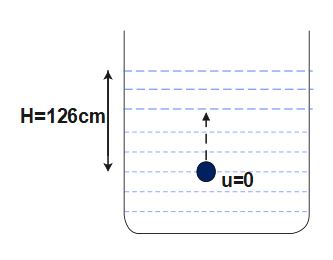
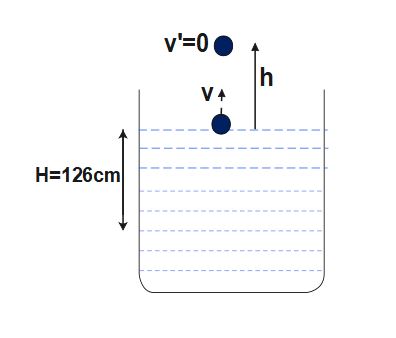
Q5.A wooden ball of density 900 kg / m^{3} is immersed in a liquid of density 1200 kg / m^{3} to a depth of 126 cm and the released. The height h above the surface of which the ball rises will be

Top 5 Fluid Mechanics problems for IIT-JEE NEET
Choose correct options among the following options.

A wooden ball of density 900 kg / m^{3} is immersed in a liquid of density 1200 kg / m^{3} to a depth of 126 cm and the released. The height h above the surface of which the ball rises will be

(A) 40 cm

(B) 42 cm

(C) 45 cm

(D) 50 cm

Solution

Let V = Volume of ball

Given that, \rho = density of ball= 900\frac{kg}{m^3}

\sigma = density of liquid =1200\frac{kg}{m^3}

As, the density of ball = \rho=\frac mV

m=V\rho

We know that F_{up}=V\sigma g\;

According to Newton's 2nd law of motion, we can write

F_{net}= F_{up}-mg

ma= V\sigma g - V\rho g

V\rho a= V\sigma g - V\rho g

a=\;\frac{V\sigma g-V\rho g}{V\rho}

a=\;\frac{(\sigma-\rho)g}\rho

a=\;\frac{(1200-900)g}{900}

a=\;\frac{(300)g}{900}

a=\;\frac{g}{3}

Now, u=0 (because the ball is released from rest)

When ball reaches to surface, S= 126 cm = 1.26 m. Also, let us assume that it attains velocity v at top surface.

According to Kinematics Equation of U.A.M., v^2-u^2=2aS

\Rightarrow v^2-0^2=2\left(\frac g3\right)\;\left(1.26\right)

\Rightarrow v^2=0.84 g .....(1)

A wooden ball of density <span class="wp-katex-eq" data-display="false">900 kg / m^{3}</span> is immersed in a liquid of density <span class="wp-katex-eq" data-display="false">1200 kg / m^{3}</span> to a depth of 126 cm and the released. The height h above the surface of which the ball rises will be

h= height the ball attains when it rises up with velocity v from top surafce

Since , the ball rises up vertically under the effect of gravity, so it would come to rest momentarily when it attains height 'h'

v^{'}=0

A =-g

(-ve sign appears as the diraction of acceleration is against motion)

Again,apply V^2-U^2=2AS

\Rightarrow\;v'^2-v^2=2(-g) h

\Rightarrow\;0^2-v^2=2(-g) h

\Rightarrow\ v^2=2gh ....(2)

From (1) and (2), we get,

0.84g = 2gh

h=\frac{0.84g}{2g}

h=0.42m=42cm

(B) is correct option

A wooden ball of density 900kg/m3900kg/m3 is immersed in a liquid of density 1200kg/m31200kg/m3 to a depth of 126 cm and the released. The height h above the surface of which the ball rises will be

Conculsion -

Top 5 Fluid Mechanics problems for IIT-JEE NEET are written so as to make you full clarity of concept of upthrust/buoyant force and law of flotation. This is an important topic from IIT-JEE and NEET point of view. In this set of Top 5 Fluid Mechanics Problems forr IIT-JEE NEET , we tried to focus on a specific use of Archimedes Principle and Newton’s Laws of Motion. It is observed that competitive exam like JEE and NEET are asking questions based on mix of various concepts instead of a plain question on single concept.

NEET (UG)

NEET, which stands for the National Eligibility cum Entrance Test, is a national-level entrance examination in India for admission to undergraduate medical courses (MBBS/BDS) in government or private medical colleges across the country. NEET is the sole entrance test for admission to medical and dental programs in India.

Key features of the NEET exam include:

  1. Eligibility:
    • Candidates must have completed 10+2 or its equivalent with Physics, Chemistry, Biology/Biotechnology, and English as mandatory subjects.
    • The minimum age limit for candidates is generally 17 years, and there is an upper age limit (with some relaxations for certain categories).
  2. Subjects and Exam Pattern:
    • NEET primarily assesses the candidates’ knowledge in Physics, Chemistry, and Biology (Botany and Zoology).
    • The exam consists of multiple-choice questions (MCQs), and each correct answer is awarded four marks, while one mark is deducted for each incorrect answer.
  3. Mode of Examination:
    • NEET is conducted in a pen-and-paper-based (offline) mode. However, there have been discussions about transitioning to a computer-based mode in the future.
  4. Syllabus:
    • The syllabus for NEET is based on the topics covered in the 11th and 12th standards, following the NCERT curriculum. It includes subjects like Physics, Chemistry, and Biology.
  5. National Testing Agency (NTA):
    • NEET is conducted by the National Testing Agency (NTA), which is responsible for the conduct of various entrance examinations in India.
  6. Admission Process:
    • NEET scores are used by medical colleges across India to admit students to MBBS and BDS programs.
    • Counseling for NEET is conducted by the Directorate General of Health Services (DGHS) and the Medical Counseling Committee (MCC), which oversee the allocation of seats in government and private medical colleges.
  7. Attempts:
    • Candidates are allowed a maximum of three attempts to appear for the NEET examination, subject to the upper age limit.

NEET replaced several individual state and university-level medical entrance exams to bring uniformity in the admission process for medical courses. It is considered one of the most challenging and competitive medical entrance exams in the country. NEET plays a crucial role in determining the eligibility of students to pursue undergraduate medical education, contributing to the standardization and transparency of the medical admissions process in India.

Top 20 Government Medical Colleges in India for M.B.B.S.

List of the “top 20 government medical colleges in India for MBBS.” We are just providing you with a list of some renowned government medical colleges in India that have historically been considered among the top. It must be noted that rankings can change, and it’s advisable to check the most recent rankings for accurate information. Here is a list (in no particular order) of some prestigious government medical colleges in India:

  1. All India Institute of Medical Sciences (AIIMS), New Delhi
  2. Armed Forces Medical College (AFMC), Pune
  3. Maulana Azad Medical College (MAMC), New Delhi
  4. JIPMER, Puducherry
  5. Grant Medical College, Mumbai
  6. King George’s Medical University (KGMU), Lucknow
  7. Lady Hardinge Medical College (LHMC), New Delhi
  8. Bangalore Medical College and Research Institute (BMCRI), Bangalore
  9. Institute of Medical Sciences, Banaras Hindu University (IMS-BHU), Varanasi
  10. Osmania Medical College, Hyderabad
  11. Madras Medical College, Chennai
  12. Government Medical College and Hospital (GMCH), Chandigarh
  13. Jawaharlal Nehru Medical College (JNMC), Aligarh
  14. Gandhi Medical College, Hyderabad
  15. Government Medical College, Thiruvananthapuram
  16. Madurai Medical College, Madurai
  17. Byramjee Jeejeebhoy Government Medical College (BJMC), Pune
  18. Stanley Medical College, Chennai
  19. Government Medical College, Kozhikode
  20. Sawai Man Singh Medical College (SMSMC), Jaipur

This list is not exhaustive, and there are many other excellent government medical colleges across India. Rankings may vary, and it’s essential to check the latest rankings and admission criteria before making any decisions. Additionally, new colleges may have gained recognition, and existing ones might have seen changes in their status since my last update.