Projectile Motion on an Inclined Plane (Up the Incline): Complete Derivation

Projectile Motion on an Inclined Plane (Up the Incline): Complete Derivation of Time of Flight, Range, Maximum Height & Condition for Maximum Range

Introduction

Projectile motion is one of the most fundamental topics in Mechanics and forms an important part of the syllabus for Class 11 Physics, CBSE, JEE Main, JEE Advanced, and NEET. While projectile motion on a horizontal surface is relatively straightforward, many students struggle when the projectile is launched on an inclined plane.

The difficulty arises because the direction of motion is no longer aligned with the conventional horizontal and vertical axes. However, by choosing an appropriate coordinate system and resolving the motion correctly, the entire derivation becomes systematic and elegant.

In this article, we will derive the following results step by step:

  • Time of Flight

  • Maximum Height Above the Inclined Plane

  • Range Along the Inclined Plane

  • Condition for Maximum Range

  • Maximum Possible Range

The focus is not on memorizing formulas but on understanding the physics behind every equation.


Problem Statement:

Projectile Motion on an Inclined

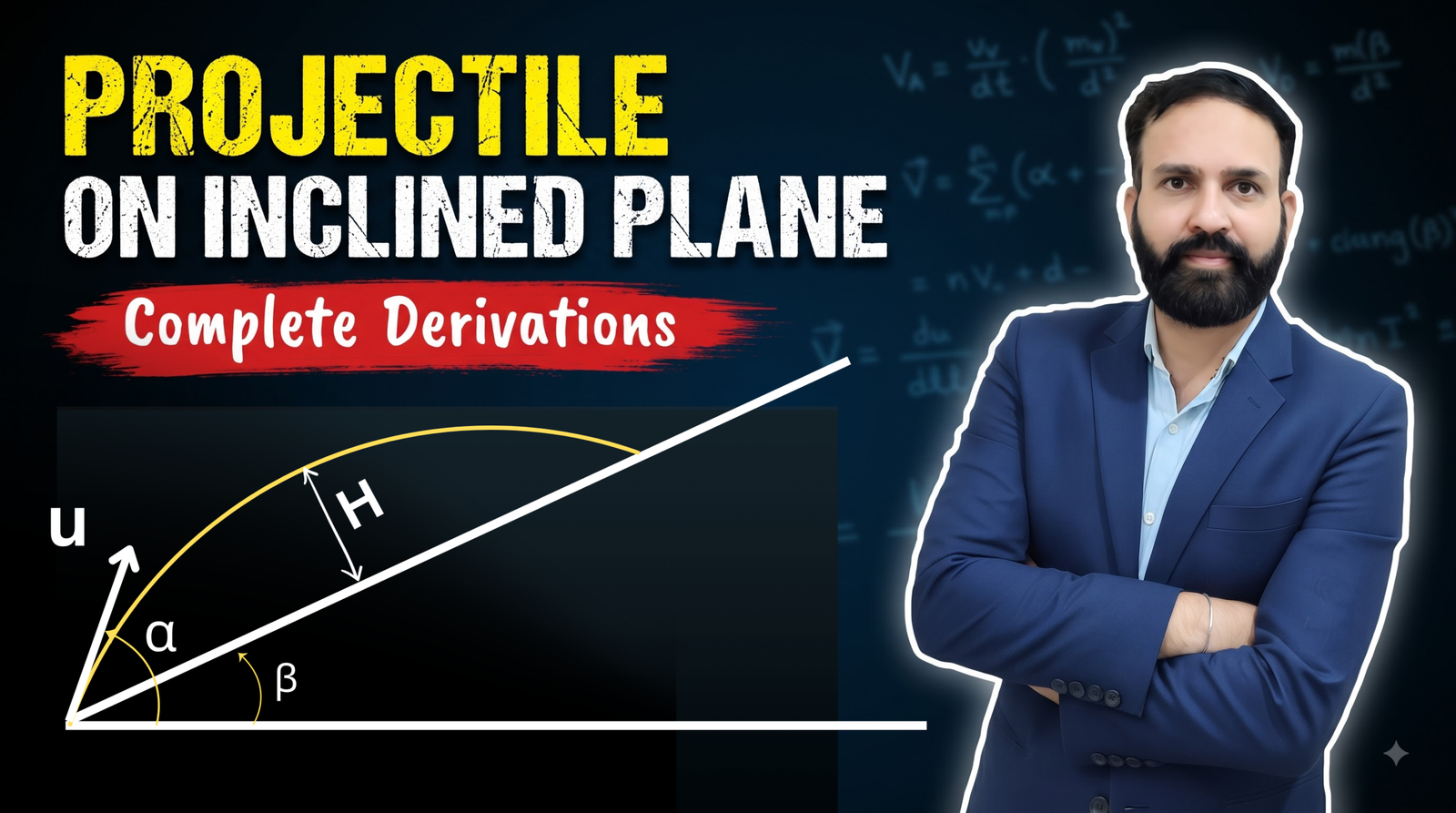
Consider a projectile projected with an initial speed u at an angle α with the horizontal.

The inclined plane makes an angle β with the horizontal.

The projectile strikes the inclined plane again after some time.

Our objective is to derive expressions for:

  • Time of Flight (T)

  • Range Along the Inclined Plane (R)

  • Maximum Height Above the Inclined Plane (Hmax)

  • Angle of Projection for Maximum Range


Understanding the Geometry of Projectile Motion on an Inclined

Unlike ordinary projectile motion, the inclined plane itself is tilted.

Instead of choosing horizontal and vertical axes, it is much more convenient to choose two mutually perpendicular directions:

  • x-axis → Along the Inclined Plane

  • y-axis → Perpendicular to the Inclined Plane

This choice simplifies the mathematics considerably because the required range is measured directly along the inclined plane.


Resolving the Initial Velocity

The initial velocity vector u makes an angle α with the horizontal.

Since the inclined plane itself is inclined at β, the angle between the velocity vector and the inclined plane becomes

(α − β)

Hence,

Component Along the Inclined Plane

ux = u cos(α − β)

Component Perpendicular to the Inclined Plane

uy = u sin(α − β)

This is the most important step in the entire derivation because every subsequent equation is based on these two velocity components.


Resolving Acceleration Due to Gravity

Gravity always acts vertically downward.

However, in our new coordinate system, gravity must also be resolved into two components.

Along the Inclined Plane

ax = g sinβ

Perpendicular to the Inclined Plane

ay = g cosβ

Depending upon the chosen positive directions, these components appear with appropriate negative signs in the kinematic equations because gravity acts opposite to the upward directions.


Derivation of Time of Flight

The motion perpendicular to the inclined plane behaves exactly like vertical projectile motion.

Initial velocity:

uy = u sin(α − β)

Acceleration:

ay = −g cosβ

Using the second equation of motion,

y = ut + ½at²

When the projectile again strikes the inclined plane,

y = 0

Substituting this condition and solving for time,

we obtain

Time of Flight

T = 2u sin(α − β) / (g cosβ)

This result shows that the total time depends only upon the motion perpendicular to the inclined plane.


Derivation of Maximum Height

At the highest point,

the velocity perpendicular to the inclined plane becomes zero.

Using

v² = u² + 2as

with

v = 0

we obtain

Maximum Height

Hmax = u² sin²(α − β) / (2g cosβ)

Notice that this expression is very similar to the standard projectile formula.

The only difference is that the effective downward acceleration is now g cosβ instead of g.


Derivation of Range Along the Inclined Plane

Now consider the motion parallel to the inclined plane.

Initial velocity:

ux = u cos(α − β)

Acceleration:

ax = −g sinβ

Using

x = ut + ½at²

and substituting the Time of Flight obtained earlier,

the expression simplifies to

Range Along the Inclined Plane

R = 2u² sin(α − β) cosα / (g cos²β)

This represents the distance measured along the inclined plane from the point of projection to the point where the projectile lands again.


Condition for Maximum Range

To determine the optimum projection angle, rewrite the range equation using trigonometric identities.

After simplification,

the range expression contains the term

sin(2α − β)

The maximum value of sine is 1.

Therefore,

2α − β = 90°

which gives

Angle of Projection for Maximum Range

α = 45° + β/2

This is one of the most frequently asked derivations in competitive examinations.

Unlike ordinary projectile motion, the optimum projection angle depends upon the inclination of the plane.


Maximum Range

Substituting the optimum angle into the range equation,

we obtain

Maximum Range

Rmax = u²(1 − sinβ)/(g cos²β)

which can further be simplified using trigonometric identities to

Rmax = u²/[g(1 + sinβ)]

This compact expression is extremely useful in numerical problems.


Important Formula Sheet

Time of Flight

T = 2u sin(α − β)/(g cosβ)

Maximum Height

Hmax = u² sin²(α − β)/(2g cosβ)

Range Along Inclined Plane

R = 2u² sin(α − β) cosα/(g cos²β)

Angle for Maximum Range

α = 45° + β/2

Maximum Range

Rmax = u²/[g(1 + sinβ)]


Common Mistakes Students Make

  • Resolving velocity into horizontal and vertical directions instead of along and perpendicular to the inclined plane.

  • Forgetting to resolve gravity into two components.

  • Using incorrect sign conventions for acceleration.

  • Applying horizontal projectile formulas directly without changing the coordinate system.

  • Memorizing formulas without understanding the derivation.


Tips for JEE Main, JEE Advanced & NEET

  • Always begin by drawing a neat diagram.

  • Resolve both velocity and gravity before writing any equation.

  • Use the motion perpendicular to the plane for Time of Flight and Maximum Height.

  • Use the motion along the plane for Range.

  • Remember that the inclined plane problem is essentially a standard projectile problem viewed in a rotated coordinate system.


Frequently Asked Questions (FAQs)

Why do we resolve motion along the inclined plane?

Because the required range is measured along the inclined plane, and the equations become much simpler in this coordinate system.

Why is the effective acceleration g cosβ in the perpendicular direction?

Only the component of gravity perpendicular to the inclined plane affects the motion in that direction.

Is this derivation important for JEE and NEET?

Yes. Questions based on inclined plane projectile motion are common in JEE Main, JEE Advanced, and occasionally in NEET.

Do I need to memorize all the formulas?

No. Once you understand the coordinate transformation and the use of kinematic equations, the formulas can be derived quickly during revision.


Conclusion

Projectile Motion on an Inclined Plane is one of the best examples of how choosing an appropriate coordinate system simplifies a seemingly difficult problem. By resolving the velocity and acceleration into components along and perpendicular to the inclined plane, we can derive the expressions for Time of Flight, Maximum Height, Range, and the Condition for Maximum Range using only basic kinematic equations.

For competitive examinations such as JEE Main, JEE Advanced, NEET, and CBSE Class 11 Physics, conceptual clarity is far more valuable than rote memorization. Once you understand the derivation, solving numerical problems becomes much easier and more intuitive.

If you found this explanation helpful, continue practicing derivations and numerical problems to strengthen your understanding of projectile motion.
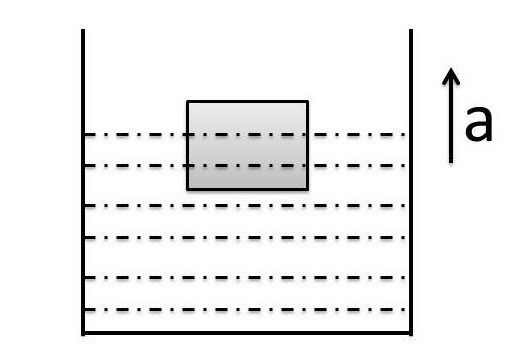
A partially immersed solid block of density [latex]\rho_s[/latex] is floating in a liquid of density [latex]\rho_L[/latex] as shown in figure. If beaker container moves up with positive acceleration ‘a’ , what is correct statement about the block?

Top 5 Fluid Mechanics problems for IIT-JEE NEET

Q.A partially immersed solid block of density \rho_s is floating in a liquid of density \rho_L as shown in figure. If beaker container moves up with positive acceleration 'a' , what is correct statement about the block ?

(A) It sinks more

(B) It sinks lesser

(C) It neither sinks more nor lesser

(D) Cannot be predicted as data is insufficient

Q2.A partially immersed solid block of <span class="wp-katex-eq" data-display="false">\rho_s</span> is floating in a liquid of density <span class="wp-katex-eq" data-display="false">\rho_L</span> as shown in figure. If beaker container moves up with positive acceleration &apos;a&apos; , what is correct statement about the block ?

Solution

Let V_{in} = Volume of block immersed in the liquid

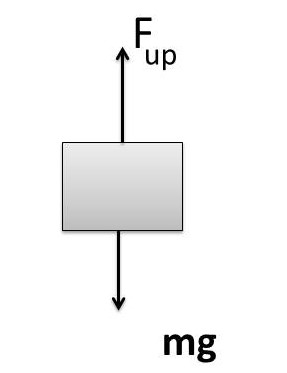
For Equilibrium of rest, see FBD as shown aside

F_{up}=V_{in}\;\rho_Lg\;=\;mg

V_{in}\;\rho_Lg\;=\;V\;\rho_S\;g\;

\;\frac{V_{in}}V\;=\frac{\rho_S}{\rho_L}

Therefore, fraction of volume inside the liquid is-

\;\frac{V_{in}}V\;=\frac{\rho_S}{\rho_L}.....(1)

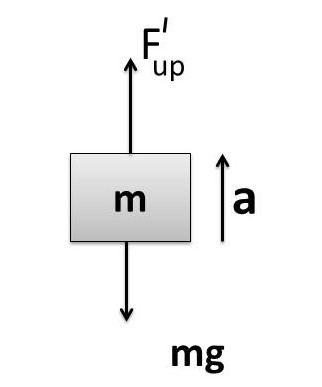
When block is moving up , the FBD is shown in figure

\;\\F_{up}^I=V_{in}^I\;\rho_L\;g_{eff}\\

F_{up}^I=V_{in}^I\;\rho_L\;(g+a).....(2)

F_{net}=F_{up}^I-mg
ma =F_{up}^I-mg
F_{up}^I=m(g+a)

F_{up}^I=V\;\rho_S\;(g+a)\\....(3)

From (2) and (3), V_{in}^I\;\rho_L\;(g+a)=V\;\rho_S\;(g+a)

\;\frac{V_{in}^I}V\;=\frac{\rho_S}{\rho_L}

\;\frac{V_{in}}V\;=\frac{\rho_S}{\rho_L}=\;\frac{V_{in}^I}V\;

Hence, fraction of volume immersed is again equal to \frac{\rho_S}{\rho_L}. It means immersed volume remains same .

Ans. (C) is correct option

Top 5 Fluid Mechanics problems for IIT-JEE NEET

Actually, this question is all about the Archimedes Principle which focus on the concept of Upthrust/Buoyant force acting on completely or partially immersed solid block or any other solid/hollow object. It helps in calculating the loss of weight when any solid substance is partially or completely immersed into the liquid. The liquid container may be stationary or moving with constant velocity/ variable velocity.

When completely or partially immersed solid block lies in stationary beaker container :- 

When beaker container is stationary then , according to Archimedes Principle , it loses its weight to equal to the weight of liquid displaced by the object (like completely or partially immersed solid block) . Therefore,

F_{up}=V_{in}\;\rho_Lg\;=\;mg

When completely or partially immersed solid block lies in beaker container moving up with constant acceleration :- 

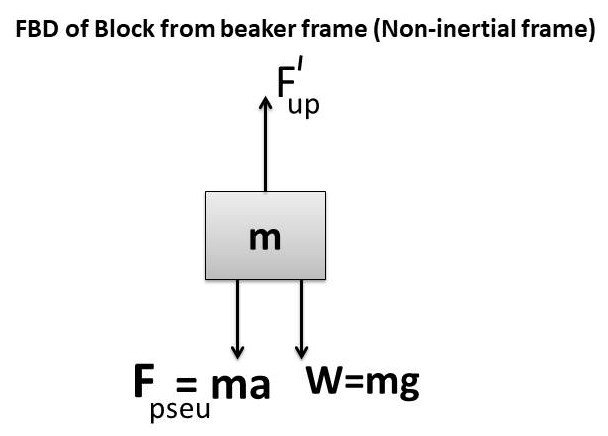
When beaker container is moving up with uniform acceleration, then the loss of weight of object is now equal to apparent weight of liquid displaced by it.Thus, buoyant force/ upthrust changes so as to balance the increased effective weight of solid block when it observed from frame of reference of accelerated beaker. 

Top 5 Fluid Mechanics problems for IIT-JEE NEET

F_{up}^I=F_{pseu}+W

F_{up}^I=ma\;+\;mg

F_{up}^I=m(g\;+\;a)

F_{up}^I=mg_{eff} where g_{eff}=g+a

Therefore, we can write

\;\\F_{up}^I=V_{in}\;\rho_L\;g_{eff}\\

F_{up}^I=V_{in}\;\rho_L\;(g+a)

Conclusion-

From the above discussion, we understand that the volume immersed does not change when the container accelerates uniformly upwards or downwards along vertical. Immersed part remains same. Block neither sinks more nor lesser. This problems is best combine of Newton’s laws of motion, Archimedes’s Principle and Law of Flotation. This is how we reach to the conclusion that the knowledge of Free Body Diagram and Pseudo force  is necessary to get into problems solving process. In fact the basic idea of pseudo force can be summarized into one line that a problem which is solved by application Newton’s 2nd law (from ground frame) gets converted into problem of Equilibrium of rest (from non-inertial frame of reference)  by introducing concept of pseudo force. 
Pseudo force can be written as:

{\overrightarrow{F\;\;}}_{pseu}=-M_{object}\;\;{\overrightarrow{a\;\;}}_{frame}
The negative sign shows that the peudo force is taken opposite to direction of acceleration of non-inertial frame.
Law of flotation simply gives us the condition under which an object floats partially or completely immersed inside the liquid. It suggest that
(i) if the density of solid is lesser than  density of liquid then it floats partially immersed in the liquid
(ii) if the density of solid is equal to the density of liquid then it floats completely immersed in the liquid
(iii) if the density of solid is more than the density of liquid then it sinks completely unitl it settles down to bottom of container.
It is very interesting to note that this law also helps to find out fraction of immersed volume of object inside the liquid. We have to understand the relationships between different concepts of mechanics to solve such type of fluid mechanics problems.

NEET (UG)

NEET, which stands for the National Eligibility cum Entrance Test, is a national-level entrance examination in India for admission to undergraduate medical courses (MBBS/BDS) in government or private medical colleges across the country. NEET is the sole entrance test for admission to medical and dental programs in India.

Key features of the NEET exam include:

  1. Eligibility:
    • Candidates must have completed 10+2 or its equivalent with Physics, Chemistry, Biology/Biotechnology, and English as mandatory subjects.
    • The minimum age limit for candidates is generally 17 years, and there is an upper age limit (with some relaxations for certain categories).
  2. Subjects and Exam Pattern:
    • NEET primarily assesses the candidates’ knowledge in Physics, Chemistry, and Biology (Botany and Zoology).
    • The exam consists of multiple-choice questions (MCQs), and each correct answer is awarded four marks, while one mark is deducted for each incorrect answer.
  3. Mode of Examination:
    • NEET is conducted in a pen-and-paper-based (offline) mode. However, there have been discussions about transitioning to a computer-based mode in the future.
  4. Syllabus:
    • The syllabus for NEET is based on the topics covered in the 11th and 12th standards, following the NCERT curriculum. It includes subjects like Physics, Chemistry, and Biology.
  5. National Testing Agency (NTA):
    • NEET is conducted by the National Testing Agency (NTA), which is responsible for the conduct of various entrance examinations in India.
  6. Admission Process:
    • NEET scores are used by medical colleges across India to admit students to MBBS and BDS programs.
    • Counseling for NEET is conducted by the Directorate General of Health Services (DGHS) and the Medical Counseling Committee (MCC), which oversee the allocation of seats in government and private medical colleges.
  7. Attempts:
    • Candidates are allowed a maximum of three attempts to appear for the NEET examination, subject to the upper age limit.

NEET replaced several individual state and university-level medical entrance exams to bring uniformity in the admission process for medical courses. It is considered one of the most challenging and competitive medical entrance exams in the country. NEET plays a crucial role in determining the eligibility of students to pursue undergraduate medical education, contributing to the standardization and transparency of the medical admissions process in India.