A small body of density ρ is dropped from rest at a height h into a lake of density σ , where σ>ρ . What would be of the acceleration of body till it moves inside the lake? (Neglect all dissipative effects)

A small body of density ρ is dropped from rest at a height h into a lake of density σ , where σ > ρ . What would be of the acceleration of body till it moves inside the lake? (Neglect all dissipative effects)

A small body of density ρ is dropped from rest at a height h into a lake of density σ , where σ > ρ . What would be of the acceleration of body till it moves inside the lake? (Neglect all dissipative effects)

(A) g\left(\frac\sigma\rho-1\right)\;downwards

(B) g\left(\frac\sigma\rho-1\right)\;upwards

(C) g\left(\frac\sigma\rho\right)\;downwards

(D) g\left(\frac\sigma\rho\right)\;upwards

Solution

Let V = Volume of body

\rho = density of body

\sigma = density of lake water

Thus, m=\;\rho\;V

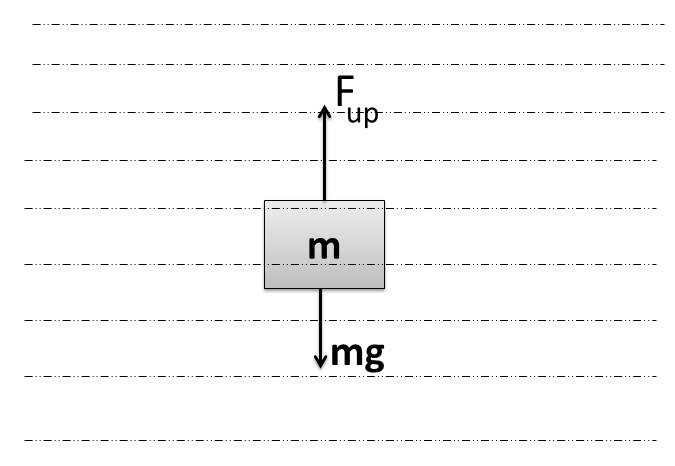
As the density of liquid is more than that of body( σ > ρ), Therefore the body has tendency to float on the liquid because of larger upwards force in comparison to that of weight of body. Hence, net force will be upwards.

W know that F_{up}=V\;\sigma g\;

According to Newton's 2nd law of motion, we can write

F_{net}= F_{up}-mg (upwards)

F_{net}= V\sigma g -V \rho g

ma = V\sigma g -V \rho g

V\rho a = V\sigma g -V \rho g

a=\frac{V(\sigma-\rho)g}{V\rho}

a=\frac{(\sigma-\rho)g}{\rho}

a=g\left(\frac\sigma\rho-1\right)\;upwards

(B) is correct option
A small body of density ρ is dropped from rest at a height h into a lake of density σ , where σ > ρ . What would be of the acceleration of body till it moves inside the lake? (Neglect all dissipative effects)

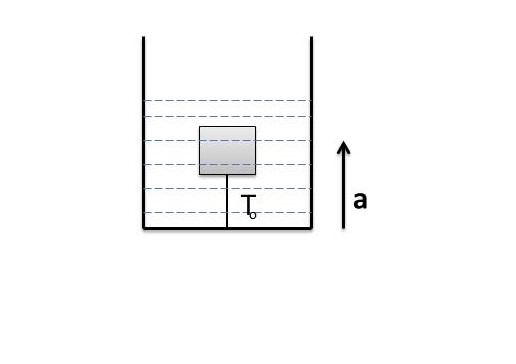
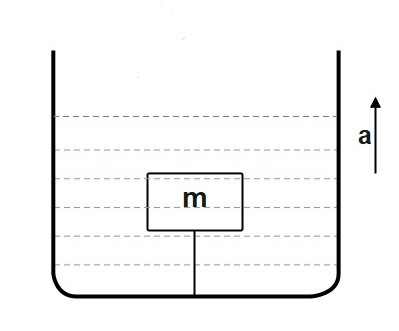
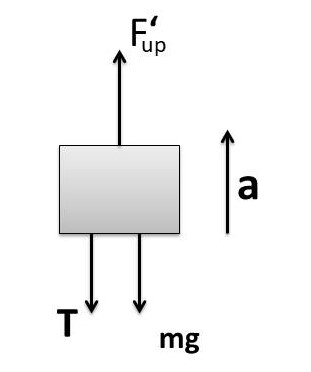
The tension in a string holding a solid block below the surface of a liquid (of density greater than that of solid) as shown in the figure is [latex]T_o[/latex] (To) when the system is at rest. What will be the tension in the string if the system has upward acceleration a.

fluid Mechanics upthrust FBD

Q1.The tension in a string holding a solid block below the surface of a liquid (of density greater than that of solid) as shown in the figure is T_o (To) when the system is at rest. What will be the tension in the string if the system has upward acceleration a.

(A) T_o\frac ag

(B) T_o\left(1-\frac ag\right)

(C) T_o\left(1+\frac ag\right)

(D) T_o\left(\frac ag-1\right)

Top 5 Fluid Mechanics problems for IIT-JEE NEET CBSE

Solution

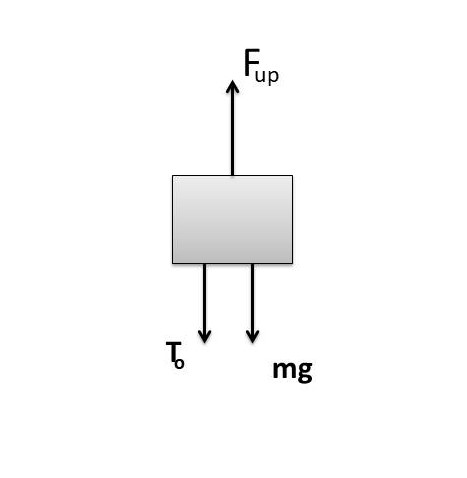
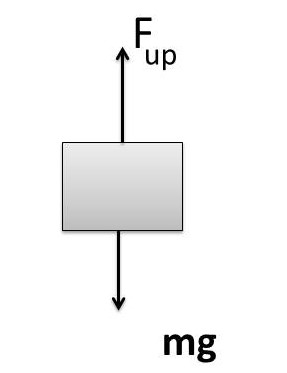
At Equilibrium (Rest), Free body diagram of block

Fluid Mechanics block fbd
T_0+mg=F_{up}
T_o+V\rho_Sg=\;\;V\rho_Lg\\
Vg(\;\rho_L-\;\rho_S)\;=T_o
\rho_L-\;\rho_S=\frac{T_o}{Vg}\;-----(1)

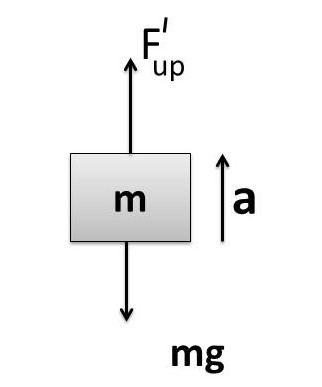
Free body diagram of block when it moves upwards.

fluid Mechanics upthrust FBD

When system moves up with acceleration 'a' then effective weight of fluid displaced also changes which is called apparent weight (of fluid displaced).

F_{up}^I=V\;\rho_L\;g_{eff}

Since, the system is moving up with acceleration 'a' .Thus, \\g_{eff}=\;g+a-----(2)

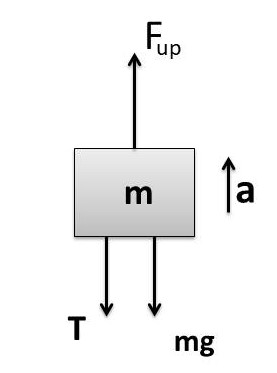
As 'a' be the acceleration of system , Use Free body diagram of the moving block

F_{net}=F_{up}^I-mg-T

Therefore, ma=V\;\rho_L\;g_{eff}-mg-T

m(\;a\;+g)=V\;\rho_L\;g_{eff}\;-T

V\;\rho_S\;(\;a\;+g)=V\;\rho_L\;g_{eff}\;-T

Now use (2), V\;\rho_S\;(\;g+a)=V\;\rho_L\;(g+a)\;-T

V\;\rho_S\;(\;g+a)=V\;\rho_L\;(g+a)\;-T

T=\;V(g+a)\;(\;\rho_L-\;\rho_S)

Using (1), T=\;V(g+a)\;({\textstyle\frac{T_o}{V\;g}})\;

Therefore, the tension in a string holding a solid block is

T=\;\;T_o\left(1+\frac ag\right)\\

Ans. (C) is correct option

Top 5 Fluid Mechanics problems for IIT-JEE NEET

Top 5 Fluid Mechanics problems for IIT-JEE NEET

Top 5 Fluid Mechanics problems for IIT-JEE NEET

Q1. from "Top 5 Fluid Mechanics problems for IIT-JEE NEET"

Q1.The tension in a string holding a solid block below the surface of a liquid (of density greater than that of solid) as shown in the figure is T_o when the system is at rest. What will be the tension in the string if the system has upward acceleration a.

Top 5 Fluid Mechanics problems for IIT-JEE NEET CBSE
Choose correct options among the following options.

Q1.The tension in a string holding a solid block below the surface of a liquid (of density greater than that of solid) as shown in the figure is T_o (To) when the system is at rest. What will be the tension in the string if the system has upward acceleration a.

(A) T_o\frac ag

(B) T_o\left(1-\frac ag\right)

(C) T_o\left(1+\frac ag\right)

(D) T_o\left(\frac ag-1\right)

Top 5 Fluid Mechanics problems for IIT-JEE NEET CBSE

Solution

At Equilibrium (Rest), Free body diagram of block

Fluid Mechanics block fbd
T_0+mg=F_{up}
T_o+V\rho_Sg=\;\;V\rho_Lg\\
Vg(\;\rho_L-\;\rho_S)\;=T_o
\rho_L-\;\rho_S=\frac{T_o}{Vg}\;-----(1)

Free body diagram of block when it moves upwards.

fluid Mechanics upthrust FBD

When system moves up with acceleration 'a' then effective weight of fluid displaced also changes which is called apparent weight (of fluid displaced).

F_{up}^I=V\;\rho_L\;g_{eff}

Since, the system is moving up with acceleration 'a' .Thus, \\g_{eff}=\;g+a-----(2)

As 'a' be the acceleration of system , Use Free body diagram of the moving block

F_{net}=F_{up}^I-mg-T

Therefore, ma=V\;\rho_L\;g_{eff}-mg-T

m(\;a\;+g)=V\;\rho_L\;g_{eff}\;-T

V\;\rho_S\;(\;a\;+g)=V\;\rho_L\;g_{eff}\;-T

Now use (2), V\;\rho_S\;(\;g+a)=V\;\rho_L\;(g+a)\;-T

V\;\rho_S\;(\;g+a)=V\;\rho_L\;(g+a)\;-T

T=\;V(g+a)\;(\;\rho_L-\;\rho_S)

Using (1), T=\;V(g+a)\;({\textstyle\frac{T_o}{V\;g}})\;

T=\;\;T_o\left(1+\frac ag\right)\\

Ans. (C) is correct option

Q2. from "Top 5 Fluid Mechanics problems for IIT-JEE NEET"

Q2. A small body of density ρ is dropped from rest at a height h into a lake of density σ , where σ > ρ . What would be of the acceleration of body till it moves inside the lake? (Neglect all dissipative effects)

g\left(\frac\sigma\rho-1\right)\;downwards
g\left(\frac\sigma\rho-1\right)\;upwards
g\left(\frac\sigma\rho\right)\;downwards
g\left(\frac\sigma\rho\right)\;upwards
A small body of density ρ is dropped from rest at a height h into a lake of density σ , where σ > ρ . What would be of the acceleration of body till it moves inside the lake? (Neglect all dissipative effects)
Choose correct options among the following options.

Q2.A small body of density ρ is dropped from rest at a height h into a lake of density σ , where σ > ρ . What would be of the acceleration of body till it moves inside the lake? (Neglect all dissipative effects)

(A) g\left(\frac\sigma\rho-1\right)\;downwards

(B) g\left(\frac\sigma\rho-1\right)\;upwards

(C) g\left(\frac\sigma\rho\right)\;downwards

(D) g\left(\frac\sigma\rho\right)\;upwards

Solution

Let V = Volume of body

\rho = density of body

\sigma = density of lake water

Thus, m=\;\rho\;V

As the density of liquid is more than that of body( σ > ρ), Therefore the body has tendency to float on the liquid because of larger upwards force in comparison to that of weight of body. Hence, net force will be upwards.

W know that F_{up}=V\;\sigma g\;

According to Newton's 2nd law of motion, we can write

F_{net}= F_{up}-mg (upwards)

F_{net}= V\sigma g -V \rho g

ma = V\sigma g -V \rho g

V\rho a = V\sigma g -V \rho g

a=\frac{V(\sigma-\rho)g}{V\rho}

a=\frac{(\sigma-\rho)g}{\rho}

a=g\left(\frac\sigma\rho-1\right)\;upwards

(B) is correct option
A small body of density ρ is dropped from rest at a height h into a lake of density σ , where σ > ρ . What would be of the acceleration of body till it moves inside the lake? (Neglect all dissipative effects)

Q3. from "Top 5 Fluid Mechanics problems for IIT-JEE NEET"

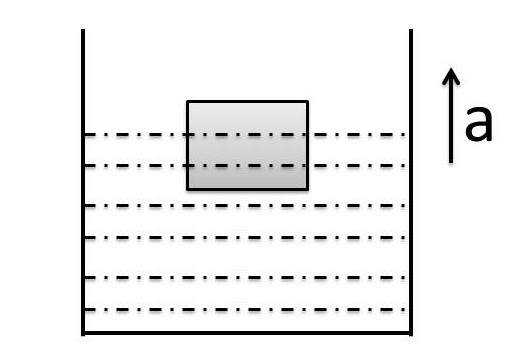
Q3.A partially immersed solid block of \rho_s is floating in a liquid of density \rho_L as shown in figure. If beaker container moves up with positive acceleration 'a' , what is correct statement about the block?

It sinks more inside the liquid

It sinks lesser inside the liquid

It neither sinks more nor lesser inside the liquid

Can not be predicted as data is insufficient

Top 5 Fluid Mechanics problems for IIT-JEE NEET
Choose correct options among the following options.

Q3.A partially immersed solid block of \rho_s is floating in a liquid of density \rho_L as shown in figure. If beaker container moves up with positive acceleration 'a' , what is correct statement about the block ?

Top 5 Fluid Mechanics problems for IIT-JEE NEET

Solution

Let V_{in} = Volume of block immersed in the liquid

For Equilibrium of rest, see FBD as shown aside

F_{up}=V_{in}\;\rho_Lg\;=\;mg

V_{in}\;\rho_Lg\;=\;V\;\rho_S\;g\;

\;\frac{V_{in}}V\;=\frac{\rho_S}{\rho_L}

Therefore, fraction of volume inside the liquid is-

\;\frac{V_{in}}V\;=\frac{\rho_S}{\rho_L}.....(1)

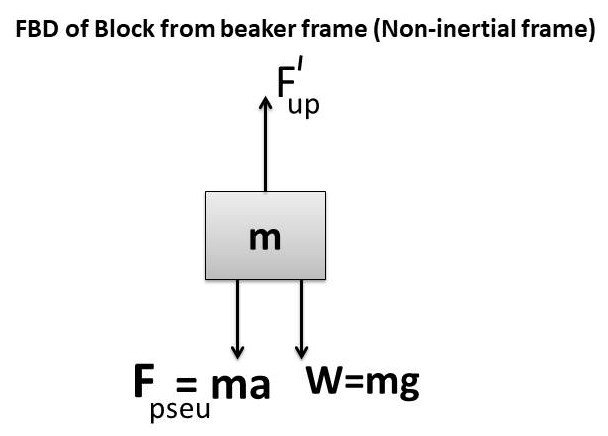
When block is moving up , the FBD is shown in figure

\;\\F_{up}^I=V_{in}^I\;\rho_L\;g_{eff}\\

F_{up}^I=V_{in}^I\;\rho_L\;(g+a).....(2)

F_{net}=F_{up}^I-mg
ma =F_{up}^I-mg
F_{up}^I=m(g+a)

F_{up}^I=V\;\rho_S\;(g+a)\\....(3)

From (2) and (3), V_{in}^I\;\rho_L\;(g+a)=V\;\rho_S\;(g+a)

\;\frac{V_{in}^I}V\;=\frac{\rho_S}{\rho_L}

\;\frac{V_{in}}V\;=\frac{\rho_S}{\rho_L}=\;\frac{V_{in}^I}V\;

Hence, fraction of volume immersed is again equal to \frac{\rho_S}{\rho_L}. It means immersed volume remains same .

Ans. (C) is correct option

Top 5 Fluid Mechanics problems for IIT-JEE NEET

Q4. from "Top 5 Fluid Mechanics problems for IIT-JEE NEET"

Q4.A block of mass 1 kg and density 0.8 g/cm^3 is held stationary with the help of a string as shown in figure. The block is completely immersed into the water filled in tank.If the tank is accelerating vertically upwards with an acceleration a = 2m/s^2. Find the tension in the string.

A block of mass 1 kg and density 0.8 <span class="wp-katex-eq" data-display="false">g/cm^3</span> is held stationary with the help of a string as shown in figure. The block is completely immersed into the water filled in tank.If the tank is accelerating vertically upwards with an acceleration a = 2<span class="wp-katex-eq" data-display="false">m/s^2</span>. Find the tension in the string.
Choose correct options among the following options.

A block of mass 1 kg and density 0.8 g/cm^3 is held stationary with the help of a string as shown in figure. The block is completely immersed into the water filled in tank.If the tank is accelerating vertically upwards with an acceleration a = 2 m/s^2.

(i) Find the tension in the string.

A block of mass 1 kg and density 0.8 <span class="wp-katex-eq" data-display="false">g/cm^3</span> is held stationary with the help of a string as shown in figure. The block is completely immersed into the water filled in tank.If the tank is accelerating vertically upwards with an acceleration a = 2<span class="wp-katex-eq" data-display="false">m/s^2</span>. Find the tension in the string.

(A) 3 N

(B) 2 N

(C) 3.5 N

(D) 5.5 N

Solution

Let V = Volume of body

\rho = density of block = 0.8 \frac{g}{cm^3}=800\frac{kg}{m^3}

\sigma = density of water =1000\frac{kg}{m^3}

We know that, the mass of block= m=\;\rho\;V

\rho=\frac mV

V=\frac m\rho

We know that F_{up}=V\sigma(g+a)\;

\Rightarrow F_{up}=\frac m\rho\sigma(g+a)\;

\Rightarrow F_{up}=\frac1{800}\ast1000\ast(10+2)=15N

According to Newton's 2nd law of motion, we can write

F_{net}= F_{up}-T- mg

ma= F_{up} -T- mg

1*2= 15-T-1*10

2= 15 - T- 10

T= 15 - 10-2=3N

(A) is correct option

Q5. from "Top 5 Fluid Mechanics problems for IIT-JEE NEET"

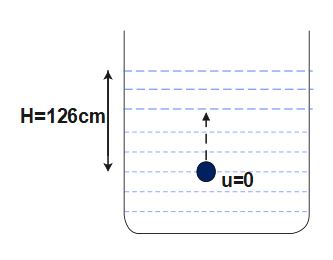
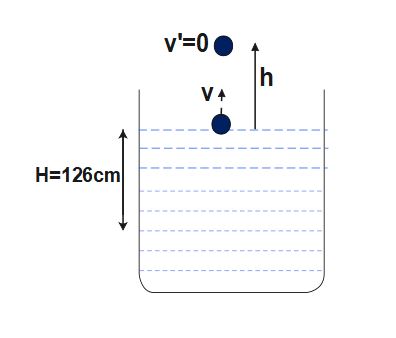
Q5.A wooden ball of density 900 kg / m^{3} is immersed in a liquid of density 1200 kg / m^{3} to a depth of 126 cm and the released. The height h above the surface of which the ball rises will be

Top 5 Fluid Mechanics problems for IIT-JEE NEET
Choose correct options among the following options.

A wooden ball of density 900 kg / m^{3} is immersed in a liquid of density 1200 kg / m^{3} to a depth of 126 cm and the released. The height h above the surface of which the ball rises will be

(A) 40 cm

(B) 42 cm

(C) 45 cm

(D) 50 cm

Solution

Let V = Volume of ball

Given that, \rho = density of ball= 900\frac{kg}{m^3}

\sigma = density of liquid =1200\frac{kg}{m^3}

As, the density of ball = \rho=\frac mV

m=V\rho

We know that F_{up}=V\sigma g\;

According to Newton's 2nd law of motion, we can write

F_{net}= F_{up}-mg

ma= V\sigma g - V\rho g

V\rho a= V\sigma g - V\rho g

a=\;\frac{V\sigma g-V\rho g}{V\rho}

a=\;\frac{(\sigma-\rho)g}\rho

a=\;\frac{(1200-900)g}{900}

a=\;\frac{(300)g}{900}

a=\;\frac{g}{3}

Now, u=0 (because the ball is released from rest)

When ball reaches to surface, S= 126 cm = 1.26 m. Also, let us assume that it attains velocity v at top surface.

According to Kinematics Equation of U.A.M., v^2-u^2=2aS

\Rightarrow v^2-0^2=2\left(\frac g3\right)\;\left(1.26\right)

\Rightarrow v^2=0.84 g .....(1)

A wooden ball of density <span class="wp-katex-eq" data-display="false">900 kg / m^{3}</span> is immersed in a liquid of density <span class="wp-katex-eq" data-display="false">1200 kg / m^{3}</span> to a depth of 126 cm and the released. The height h above the surface of which the ball rises will be

h= height the ball attains when it rises up with velocity v from top surafce

Since , the ball rises up vertically under the effect of gravity, so it would come to rest momentarily when it attains height 'h'

v^{'}=0

A =-g

(-ve sign appears as the diraction of acceleration is against motion)

Again,apply V^2-U^2=2AS

\Rightarrow\;v'^2-v^2=2(-g) h

\Rightarrow\;0^2-v^2=2(-g) h

\Rightarrow\ v^2=2gh ....(2)

From (1) and (2), we get,

0.84g = 2gh

h=\frac{0.84g}{2g}

h=0.42m=42cm

(B) is correct option

A wooden ball of density 900kg/m3900kg/m3 is immersed in a liquid of density 1200kg/m31200kg/m3 to a depth of 126 cm and the released. The height h above the surface of which the ball rises will be

Conculsion -

Top 5 Fluid Mechanics problems for IIT-JEE NEET are written so as to make you full clarity of concept of upthrust/buoyant force and law of flotation. This is an important topic from IIT-JEE and NEET point of view. In this set of Top 5 Fluid Mechanics Problems forr IIT-JEE NEET , we tried to focus on a specific use of Archimedes Principle and Newton’s Laws of Motion. It is observed that competitive exam like JEE and NEET are asking questions based on mix of various concepts instead of a plain question on single concept.

NEET (UG)

NEET, which stands for the National Eligibility cum Entrance Test, is a national-level entrance examination in India for admission to undergraduate medical courses (MBBS/BDS) in government or private medical colleges across the country. NEET is the sole entrance test for admission to medical and dental programs in India.

Key features of the NEET exam include:

  1. Eligibility:
    • Candidates must have completed 10+2 or its equivalent with Physics, Chemistry, Biology/Biotechnology, and English as mandatory subjects.
    • The minimum age limit for candidates is generally 17 years, and there is an upper age limit (with some relaxations for certain categories).
  2. Subjects and Exam Pattern:
    • NEET primarily assesses the candidates’ knowledge in Physics, Chemistry, and Biology (Botany and Zoology).
    • The exam consists of multiple-choice questions (MCQs), and each correct answer is awarded four marks, while one mark is deducted for each incorrect answer.
  3. Mode of Examination:
    • NEET is conducted in a pen-and-paper-based (offline) mode. However, there have been discussions about transitioning to a computer-based mode in the future.
  4. Syllabus:
    • The syllabus for NEET is based on the topics covered in the 11th and 12th standards, following the NCERT curriculum. It includes subjects like Physics, Chemistry, and Biology.
  5. National Testing Agency (NTA):
    • NEET is conducted by the National Testing Agency (NTA), which is responsible for the conduct of various entrance examinations in India.
  6. Admission Process:
    • NEET scores are used by medical colleges across India to admit students to MBBS and BDS programs.
    • Counseling for NEET is conducted by the Directorate General of Health Services (DGHS) and the Medical Counseling Committee (MCC), which oversee the allocation of seats in government and private medical colleges.
  7. Attempts:
    • Candidates are allowed a maximum of three attempts to appear for the NEET examination, subject to the upper age limit.

NEET replaced several individual state and university-level medical entrance exams to bring uniformity in the admission process for medical courses. It is considered one of the most challenging and competitive medical entrance exams in the country. NEET plays a crucial role in determining the eligibility of students to pursue undergraduate medical education, contributing to the standardization and transparency of the medical admissions process in India.

IIT JEE (Main & Advanced)

The Indian Institutes of Technology Joint Entrance Examination, commonly referred to as IIT JEE Main, stands as a formidable challenge for aspiring engineers across India. This highly competitive examination is a gateway to some of the most prestigious engineering institutes in the country. In this blog, we’ll delve into the intricacies of the IIT JEE Main examination, exploring its structure, challenges, and the transformative journey it entails for countless students.

Understanding the Examination:

IIT JEE Main is a two-tier examination conducted by the National Testing Agency (NTA). The first tier is the Main examination, which serves as a qualifying round for the JEE Advanced, the gateway to the esteemed Indian Institutes of Technology (IITs). The exam evaluates candidates in three core subjects – Physics, Chemistry, and Mathematics – and assesses their problem-solving abilities and analytical skills.

Structure of IIT JEE Main:

  1. Paper Pattern: The JEE Main examination consists of multiple-choice questions (MCQs) and numerical value-based questions. The paper is divided into three sections, one for each subject, with equal weightage given to Physics, Chemistry, and Mathematics.
  2. Mode of Examination: JEE Main is conducted in two modes: Computer-Based Test (CBT) and Pen-and-Paper-Based Test (PBT). The computer-based test allows candidates to navigate through questions on a computer, while the pen-and-paper-based test involves answering questions on a physical answer sheet.
  3. Scoring and Ranking: Candidates are awarded four marks for each correct answer, and one mark is deducted for every incorrect answer. The total marks obtained determine the candidate’s rank in the examination, with higher ranks providing better chances of securing admission to premier engineering institutes.

    The Joint Entrance Examination Advanced, commonly known as JEE Advanced, is a prestigious and highly competitive examination in India. It is the second stage of the two-tier JEE exam system, the first being JEE Main. JEE Advanced is conducted annually for admission to the undergraduate programs offered by the Indian Institutes of Technology (IITs) and a few other top engineering institutes.

    Key features of JEE Advanced:

    1. Eligibility: Only candidates who have successfully cleared the JEE Main examination are eligible to appear for JEE Advanced. The top 2.5 lakh (approximately) candidates from JEE Main are eligible to register for JEE Advanced.
    2. IIT Admission: JEE Advanced is the gateway for admission to the coveted Indian Institutes of Technology (IITs), which are known for their excellence in engineering and technology education. It is also used for admissions to some other premier institutes, including the Indian Institutes of Science Education and Research (IISERs) and the Indian Institute of Science (IISc).
    3. Exam Pattern: JEE Advanced has a different exam pattern compared to JEE Main. The examination typically consists of two papers, Paper 1 and Paper 2, each containing questions from Physics, Chemistry, and Mathematics. The questions are designed to test a candidate’s understanding of concepts, analytical ability, and problem-solving skills.
    4. IIT Zonal Coordinating IIT: Each year, one of the IITs is chosen to be the organizing institute for JEE Advanced. The organizing institute is responsible for conducting the examination, and the responsibility rotates among the IITs.
    5. Online Mode: JEE Advanced is usually conducted in the online mode (Computer-Based Test). This format allows for efficient and secure administration of the exam.
    6. Multiple Attempts: A candidate is allowed a maximum of two consecutive attempts at JEE Advanced. The attempt in the year in which the candidate passes Class 12 is considered their first attempt.
    7. Admission Based on Rank: Admissions to various undergraduate programs in IITs are based on the rank secured by candidates in the JEE Advanced examination. The counseling and seat allocation process is conducted through the Joint Seat Allocation Authority (JoSAA).

    JEE Advanced is renowned for its difficulty level and is considered one of the toughest engineering entrance exams in the country. Success in JEE Advanced opens up opportunities for students to pursue cutting-edge engineering and technology education at the premier IITs, shaping their careers in the field of science and technology.

    JEE Main and JEE Advanced are both important examinations in India for admission to undergraduate engineering programs. Here are the key differences between JEE Main and JEE Advanced:
    1. Purpose:
      • JEE Main: It is the first stage of the Joint Entrance Examination and serves as a qualifying exam for various undergraduate engineering programs in India. It is the gateway for admission to National Institutes of Technology (NITs), Indian Institutes of Information Technology (IIITs), and other government-funded technical institutes.
      • JEE Advanced: It is the second stage and is conducted for admission to the prestigious Indian Institutes of Technology (IITs) and a few other top engineering institutes in India.
    2. Eligibility:
      • JEE Main: Candidates who have completed their 10+2 education or equivalent can appear for JEE Main. It is open to all candidates who meet the eligibility criteria, and there is no restriction on the number of attempts.
      • JEE Advanced: Only the top candidates (usually around 2.5 lakh) from JEE Main are eligible to appear for JEE Advanced. This makes JEE Advanced a more exclusive and challenging examination.
    3. Exam Pattern:
      • JEE Main: The exam consists of multiple-choice questions (MCQs) and numerical value-based questions. It assesses the candidate’s understanding of Physics, Chemistry, and Mathematics.
      • JEE Advanced: The exam also includes multiple-choice questions, but it is known for its more complex and challenging problems. It aims to evaluate a candidate’s analytical thinking, problem-solving skills, and a deep understanding of concepts.
    4. Number of Papers:
      • JEE Main: There is a single paper with questions from Physics, Chemistry, and Mathematics.
      • JEE Advanced: The examination consists of two papers, Paper 1 and Paper 2, each with questions from the same three subjects.
    5. Mode of Examination:
      • JEE Main: It is conducted in both online (Computer-Based Test) and offline (Pen-and-Paper Based Test) modes.
      • JEE Advanced: It is typically conducted in online mode (Computer-Based Test).
    6. Admission Process:
      • JEE Main: The scores of JEE Main are used for admission to NITs, IIITs, and other GFTIs. It is also a qualifying criterion for JEE Advanced.
      • JEE Advanced: The ranks obtained in JEE Advanced determine admission to IITs and a few other top engineering institutes. The counseling and seat allocation process is managed by the Joint Seat Allocation Authority (JoSAA).

    In summary, while JEE Main is the first step for admission to various engineering institutes, JEE Advanced is the subsequent stage for those seeking admission to the prestigious Indian Institutes of Technology (IITs) and a few other elite institutions. The difficulty level of JEE Advanced is generally higher than that of JEE Main.

    IIT JEE Main/Advanced is not just an examination; it’s a rite of passage that has the power to shape the future of aspiring engineers. Beyond the challenges lie opportunities for growth, learning, and the fulfillment of lifelong dreams. As candidates embark on this transformative journey, they are not merely preparing for an exam but laying the foundation for a promising future in the dynamic field of engineering.

Top 20 Government Medical Colleges in India for M.B.B.S.

List of the “top 20 government medical colleges in India for MBBS.” We are just providing you with a list of some renowned government medical colleges in India that have historically been considered among the top. It must be noted that rankings can change, and it’s advisable to check the most recent rankings for accurate information. Here is a list (in no particular order) of some prestigious government medical colleges in India:

  1. All India Institute of Medical Sciences (AIIMS), New Delhi
  2. Armed Forces Medical College (AFMC), Pune
  3. Maulana Azad Medical College (MAMC), New Delhi
  4. JIPMER, Puducherry
  5. Grant Medical College, Mumbai
  6. King George’s Medical University (KGMU), Lucknow
  7. Lady Hardinge Medical College (LHMC), New Delhi
  8. Bangalore Medical College and Research Institute (BMCRI), Bangalore
  9. Institute of Medical Sciences, Banaras Hindu University (IMS-BHU), Varanasi
  10. Osmania Medical College, Hyderabad
  11. Madras Medical College, Chennai
  12. Government Medical College and Hospital (GMCH), Chandigarh
  13. Jawaharlal Nehru Medical College (JNMC), Aligarh
  14. Gandhi Medical College, Hyderabad
  15. Government Medical College, Thiruvananthapuram
  16. Madurai Medical College, Madurai
  17. Byramjee Jeejeebhoy Government Medical College (BJMC), Pune
  18. Stanley Medical College, Chennai
  19. Government Medical College, Kozhikode
  20. Sawai Man Singh Medical College (SMSMC), Jaipur

This list is not exhaustive, and there are many other excellent government medical colleges across India. Rankings may vary, and it’s essential to check the latest rankings and admission criteria before making any decisions. Additionally, new colleges may have gained recognition, and existing ones might have seen changes in their status since my last update.