Projectile Motion on an Inclined Plane (Up the Incline): Complete Derivation of Time of Flight, Range, Maximum Height & Condition for Maximum Range
Introduction
Projectile motion is one of the most fundamental topics in Mechanics and forms an important part of the syllabus for Class 11 Physics, CBSE, JEE Main, JEE Advanced, and NEET. While projectile motion on a horizontal surface is relatively straightforward, many students struggle when the projectile is launched on an inclined plane.
The difficulty arises because the direction of motion is no longer aligned with the conventional horizontal and vertical axes. However, by choosing an appropriate coordinate system and resolving the motion correctly, the entire derivation becomes systematic and elegant.
In this article, we will derive the following results step by step:
-
Time of Flight
-
Maximum Height Above the Inclined Plane
-
Range Along the Inclined Plane
-
Condition for Maximum Range
-
Maximum Possible Range
The focus is not on memorizing formulas but on understanding the physics behind every equation.
Problem Statement:
Projectile Motion on an Inclined
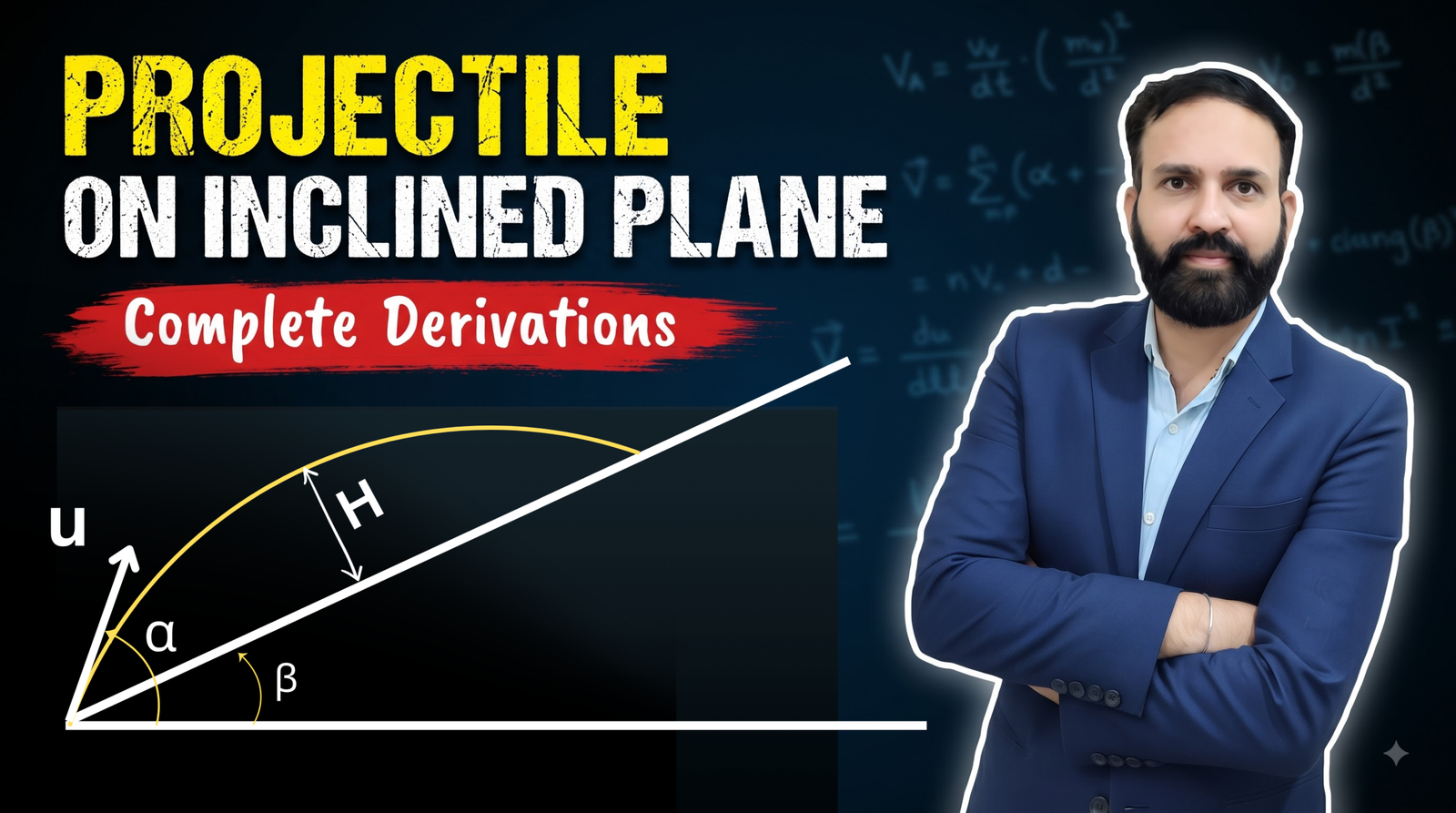
Consider a projectile projected with an initial speed u at an angle α with the horizontal.
The inclined plane makes an angle β with the horizontal.
The projectile strikes the inclined plane again after some time.
Our objective is to derive expressions for:
-
Time of Flight (T)
-
Range Along the Inclined Plane (R)
-
Maximum Height Above the Inclined Plane (Hmax)
-
Angle of Projection for Maximum Range
Understanding the Geometry of Projectile Motion on an Inclined
Unlike ordinary projectile motion, the inclined plane itself is tilted.
Instead of choosing horizontal and vertical axes, it is much more convenient to choose two mutually perpendicular directions:
x-axis → Along the Inclined Plane
y-axis → Perpendicular to the Inclined Plane
This choice simplifies the mathematics considerably because the required range is measured directly along the inclined plane.
Resolving the Initial Velocity
The initial velocity vector u makes an angle α with the horizontal.
Since the inclined plane itself is inclined at β, the angle between the velocity vector and the inclined plane becomes
(α − β)
Hence,
Component Along the Inclined Plane
ux = u cos(α − β)
Component Perpendicular to the Inclined Plane
uy = u sin(α − β)
This is the most important step in the entire derivation because every subsequent equation is based on these two velocity components.
Resolving Acceleration Due to Gravity
Gravity always acts vertically downward.
However, in our new coordinate system, gravity must also be resolved into two components.
Along the Inclined Plane
ax = g sinβ
Perpendicular to the Inclined Plane
ay = g cosβ
Depending upon the chosen positive directions, these components appear with appropriate negative signs in the kinematic equations because gravity acts opposite to the upward directions.
Derivation of Time of Flight
The motion perpendicular to the inclined plane behaves exactly like vertical projectile motion.
Initial velocity:
uy = u sin(α − β)
Acceleration:
ay = −g cosβ
Using the second equation of motion,
y = ut + ½at²
When the projectile again strikes the inclined plane,
y = 0
Substituting this condition and solving for time,
we obtain
Time of Flight
T = 2u sin(α − β) / (g cosβ)
This result shows that the total time depends only upon the motion perpendicular to the inclined plane.
Derivation of Maximum Height
At the highest point,
the velocity perpendicular to the inclined plane becomes zero.
Using
v² = u² + 2as
with
v = 0
we obtain
Maximum Height
Hmax = u² sin²(α − β) / (2g cosβ)
Notice that this expression is very similar to the standard projectile formula.
The only difference is that the effective downward acceleration is now g cosβ instead of g.
Derivation of Range Along the Inclined Plane
Now consider the motion parallel to the inclined plane.
Initial velocity:
ux = u cos(α − β)
Acceleration:
ax = −g sinβ
Using
x = ut + ½at²
and substituting the Time of Flight obtained earlier,
the expression simplifies to
Range Along the Inclined Plane
R = 2u² sin(α − β) cosα / (g cos²β)
This represents the distance measured along the inclined plane from the point of projection to the point where the projectile lands again.
Condition for Maximum Range
To determine the optimum projection angle, rewrite the range equation using trigonometric identities.
After simplification,
the range expression contains the term
sin(2α − β)
The maximum value of sine is 1.
Therefore,
2α − β = 90°
which gives
Angle of Projection for Maximum Range
α = 45° + β/2
This is one of the most frequently asked derivations in competitive examinations.
Unlike ordinary projectile motion, the optimum projection angle depends upon the inclination of the plane.
Maximum Range
Substituting the optimum angle into the range equation,
we obtain
Maximum Range
Rmax = u²(1 − sinβ)/(g cos²β)
which can further be simplified using trigonometric identities to
Rmax = u²/[g(1 + sinβ)]
This compact expression is extremely useful in numerical problems.
Important Formula Sheet
Time of Flight
T = 2u sin(α − β)/(g cosβ)
Maximum Height
Hmax = u² sin²(α − β)/(2g cosβ)
Range Along Inclined Plane
R = 2u² sin(α − β) cosα/(g cos²β)
Angle for Maximum Range
α = 45° + β/2
Maximum Range
Rmax = u²/[g(1 + sinβ)]
Common Mistakes Students Make
Resolving velocity into horizontal and vertical directions instead of along and perpendicular to the inclined plane.
Forgetting to resolve gravity into two components.
Using incorrect sign conventions for acceleration.
Applying horizontal projectile formulas directly without changing the coordinate system.
Memorizing formulas without understanding the derivation.
Tips for JEE Main, JEE Advanced & NEET
Always begin by drawing a neat diagram.
Resolve both velocity and gravity before writing any equation.
Use the motion perpendicular to the plane for Time of Flight and Maximum Height.
Use the motion along the plane for Range.
Remember that the inclined plane problem is essentially a standard projectile problem viewed in a rotated coordinate system.
Frequently Asked Questions (FAQs)
Why do we resolve motion along the inclined plane?
Because the required range is measured along the inclined plane, and the equations become much simpler in this coordinate system.
Why is the effective acceleration g cosβ in the perpendicular direction?
Only the component of gravity perpendicular to the inclined plane affects the motion in that direction.
Is this derivation important for JEE and NEET?
Yes. Questions based on inclined plane projectile motion are common in JEE Main, JEE Advanced, and occasionally in NEET.
Do I need to memorize all the formulas?
No. Once you understand the coordinate transformation and the use of kinematic equations, the formulas can be derived quickly during revision.
Conclusion
Projectile Motion on an Inclined Plane is one of the best examples of how choosing an appropriate coordinate system simplifies a seemingly difficult problem. By resolving the velocity and acceleration into components along and perpendicular to the inclined plane, we can derive the expressions for Time of Flight, Maximum Height, Range, and the Condition for Maximum Range using only basic kinematic equations.
For competitive examinations such as JEE Main, JEE Advanced, NEET, and CBSE Class 11 Physics, conceptual clarity is far more valuable than rote memorization. Once you understand the derivation, solving numerical problems becomes much easier and more intuitive.
If you found this explanation helpful, continue practicing derivations and numerical problems to strengthen your understanding of projectile motion.