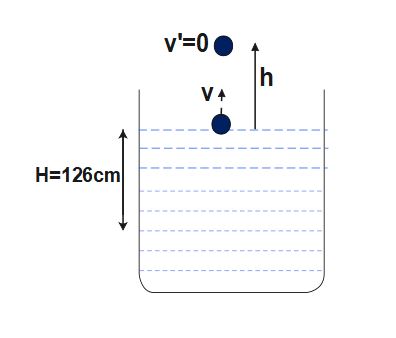
A wooden ball of density [latex]900 kg / m^{3}[/latex] is immersed in a liquid of density [latex]1200 kg / m^{3}[/latex] to a depth of 126 cm and the released. The height h above the surface of which the ball rises will be

A wooden ball of density [latex]900 kg / m^{3}[/latex] is immersed in a liquid of density [latex]1200 kg / m^{3}[/latex] to a depth of 126 cm and the released. The height h above the surface of which the ball rises will be

A wooden ball of density 900 kg / m^{3} is immersed in a liquid of density 1200 kg / m^{3} to a depth of 126 cm and the released. The height h above the surface of which the ball rises will be

(A) 40 cm

(B) 42 cm

(C) 45 cm

(D) 50 cm

Solution

Let V = Volume of ball

Given that, \rho = density of wooden ball= 900\frac{kg}{m^3}

\sigma = density of liquid =1200\frac{kg}{m^3}

As, the density of wooden ball = \rho=\frac mV

m=V\rho

We know that F_{up}=V\sigma g\;

According to Newton's 2nd law of motion, we can write

F_{net}= F_{up}-mg

ma= V\sigma g - V\rho g

V\rho a= V\sigma g - V\rho g

a=\;\frac{V\sigma g-V\rho g}{V\rho}

a=\;\frac{(\sigma-\rho)g}\rho

a=\;\frac{(1200-900)g}{900}

a=\;\frac{(300)g}{900}

a=\;\frac{g}{3}

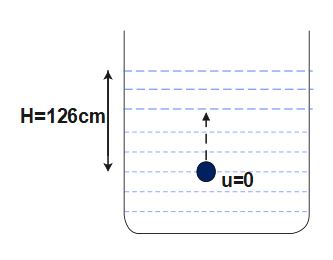
Now, u=0 (because the ball is released from rest)

When ball reaches to surface, S= 126 cm = 1.26 m. Also, let us assume that it attains velocity v at top surface.

According to Kinematics Equation of U.A.M., v^2-u^2=2aS

\Rightarrow v^2-0^2=2\left(\frac g3\right)\;\left(1.26\right)

\Rightarrow v^2=0.84 g .....(1)

A wooden ball of density <span class="wp-katex-eq" data-display="false">900 kg / m^{3}</span> is immersed in a liquid of density <span class="wp-katex-eq" data-display="false">1200 kg / m^{3}</span> to a depth of 126 cm and the released. The height h above the surface of which the ball rises will be

h= height the wooden ball attains when it rises up with velocity v from top surafce

Since , the wooden ball rises up vertically under the effect of gravity, so it would come to rest momentarily when it attains height 'h'

v^{'}=0

A =-g

(-ve sign appears as the diraction of acceleration is against motion)

Again,apply V^2-U^2=2AS

\Rightarrow\;v'^2-v^2=2(-g) h

\Rightarrow\;0^2-v^2=2(-g) h

\Rightarrow\ v^2=2gh ....(2)

From (1) and (2), we get,

0.84g = 2gh

h=\frac{0.84g}{2g}

h=0.42m=42cm

(B) is correct option

A wooden ball of density 900kg/m3900kg/m3 is immersed in a liquid of density 1200kg/m31200kg/m3 to a depth of 126 cm and the released. The height h above the surface of which the ball rises will be

A block of mass 1 kg and density 0.8 [latex]g/cm^3[/latex] is held stationary with the help of a string as shown in figure. The block is completely immersed into the water filled in tank.If the tank is accelerating vertically upwards with an acceleration a = 2[latex]m/s^2[/latex]. Find the tension in the string.

A block of mass 1 kg and density 0.8 [latex]g/cm^3[/latex] is held stationary with the help of a string as shown in figure. The block is completely immersed into the water filled in tank.If the tank is accelerating vertically upwards with an acceleration a = 2[latex]m/s^2[/latex]. Find the tension in the string.

A block of mass 1 kg and density 0.8 g/cm^3 is held stationary with the help of a string as shown in figure. The block is completely immersed into the water filled in tank.If the tank is accelerating vertically upwards with an acceleration a = 2 m/s^2.

(i) Find the tension in the string.

A block of mass 1 kg and density 0.8 <span class="wp-katex-eq" data-display="false">g/cm^3</span> is held stationary with the help of a string as shown in figure. The block is completely immersed into the water filled in tank.If the tank is accelerating vertically upwards with an acceleration a = 2<span class="wp-katex-eq" data-display="false">m/s^2</span>. Find the tension in the string.

(A) 3 N

(B) 2 N

(C) 3.5 N

(D) 5.5 N

Solution

Let V = Volume of body

\rho = density of block = 0.8 \frac{g}{cm^3}=800\frac{kg}{m^3}
\sigma = density of water =1000\frac{kg}{m^3}

We know that, the mass of block= m=\;\rho\;V

\rho=\frac mV

V=\frac m\rho

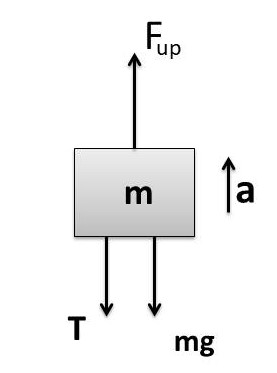
We know that F_{up}=V\sigma(g+a)\;

\Rightarrow F_{up}=\frac m\rho\sigma(g+a)\;

\Rightarrow F_{up}=\frac1{800}\ast1000\ast(10+2)=15N

According to Newton's 2nd law of motion, we can write

F_{net}= F_{up}-T- mg

ma= F_{up} -T- mg

1*2= 15-T-1*10

2= 15 - T- 10

T= 15 - 10-2=3N

(A) is correct option

(ii) Determine the acceleration produced in the of block when the string is cut off.

(A) 3 ms^{-2} downwards

(B) 3 ms^{-2} upwards

(C) 2 ms^{-2} upwards

(D) 5 ms^{-2} upwards

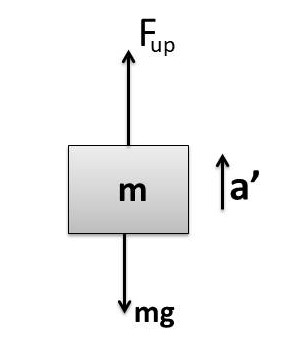
When string is cut off then T=0 and the block will move upwards due to upwards force as density of block is lesser than that of water.

We know that, the acceleration = a^{'}=\frac{F_{net}}m

a^{'}=\frac{F_{up}-mg}m=\;\frac{15-1\ast10}1=\frac{15-10}1=5\;ms^{-2}

(D) is correct option

A block of mass 1 kg and density 0.8 <span class="wp-katex-eq" data-display="false">g/cm^3</span> is held stationary with the help of a string as shown in figure. The block is completely immersed into the water filled in tank.If the tank is accelerating vertically upwards with an acceleration a = 2 <span class="wp-katex-eq" data-display="false">m/s^2.</span>