Archives 2026

Projectile Motion on an Inclined Plane (Up the Incline): Complete Derivation

Projectile Motion on an Inclined Plane (Up the Incline): Complete Derivation of Time of Flight, Range, Maximum Height & Condition for Maximum Range

Introduction

Projectile motion is one of the most fundamental topics in Mechanics and forms an important part of the syllabus for Class 11 Physics, CBSE, JEE Main, JEE Advanced, and NEET. While projectile motion on a horizontal surface is relatively straightforward, many students struggle when the projectile is launched on an inclined plane.

The difficulty arises because the direction of motion is no longer aligned with the conventional horizontal and vertical axes. However, by choosing an appropriate coordinate system and resolving the motion correctly, the entire derivation becomes systematic and elegant.

In this article, we will derive the following results step by step:

  • Time of Flight

  • Maximum Height Above the Inclined Plane

  • Range Along the Inclined Plane

  • Condition for Maximum Range

  • Maximum Possible Range

The focus is not on memorizing formulas but on understanding the physics behind every equation.


Problem Statement:

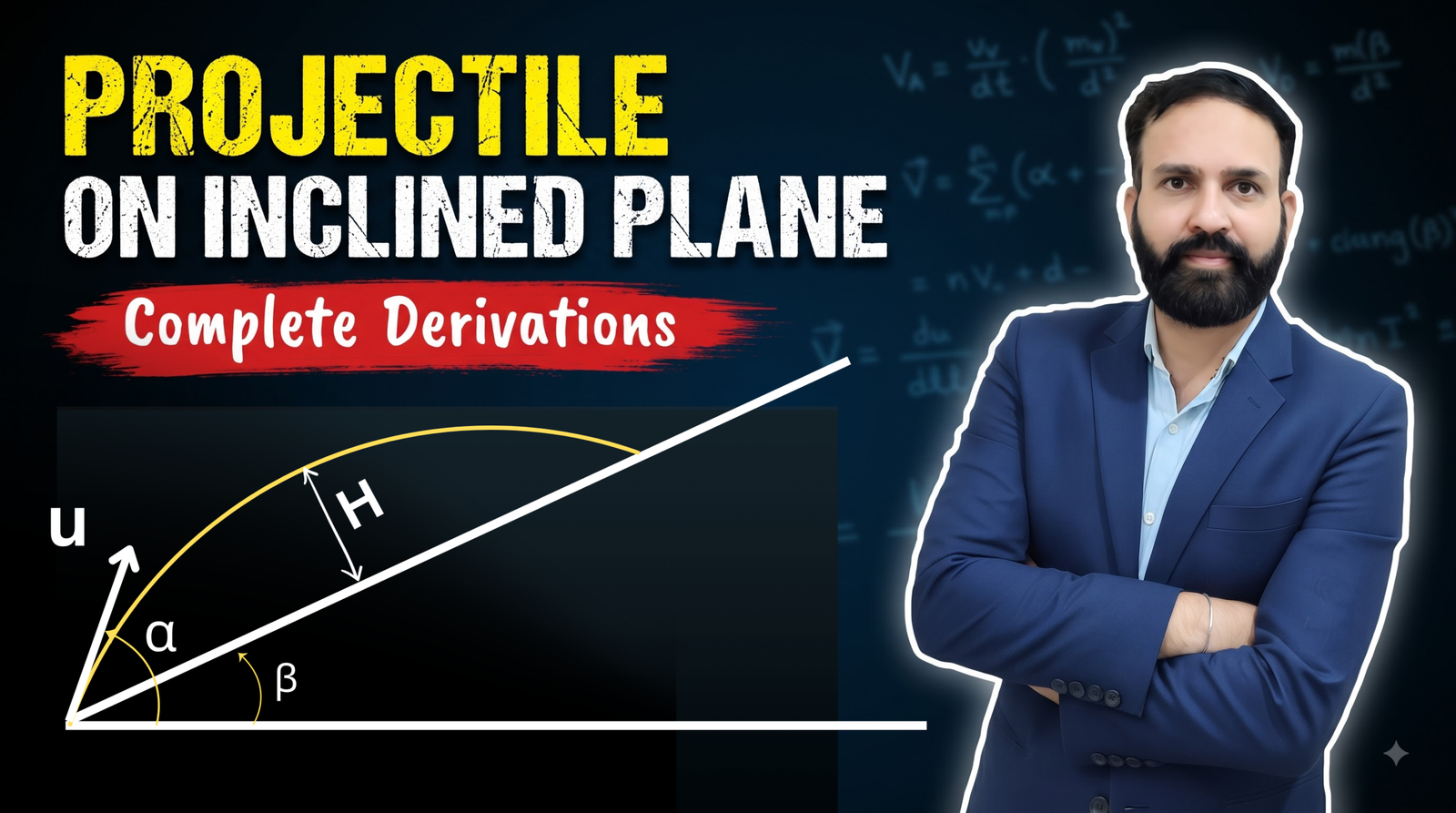
Projectile Motion on an Inclined

Consider a projectile projected with an initial speed u at an angle α with the horizontal.

The inclined plane makes an angle β with the horizontal.

The projectile strikes the inclined plane again after some time.

Our objective is to derive expressions for:

  • Time of Flight (T)

  • Range Along the Inclined Plane (R)

  • Maximum Height Above the Inclined Plane (Hmax)

  • Angle of Projection for Maximum Range


Understanding the Geometry of Projectile Motion on an Inclined

Unlike ordinary projectile motion, the inclined plane itself is tilted.

Instead of choosing horizontal and vertical axes, it is much more convenient to choose two mutually perpendicular directions:

  • x-axis → Along the Inclined Plane

  • y-axis → Perpendicular to the Inclined Plane

This choice simplifies the mathematics considerably because the required range is measured directly along the inclined plane.


Resolving the Initial Velocity

The initial velocity vector u makes an angle α with the horizontal.

Since the inclined plane itself is inclined at β, the angle between the velocity vector and the inclined plane becomes

(α − β)

Hence,

Component Along the Inclined Plane

ux = u cos(α − β)

Component Perpendicular to the Inclined Plane

uy = u sin(α − β)

This is the most important step in the entire derivation because every subsequent equation is based on these two velocity components.


Resolving Acceleration Due to Gravity

Gravity always acts vertically downward.

However, in our new coordinate system, gravity must also be resolved into two components.

Along the Inclined Plane

ax = g sinβ

Perpendicular to the Inclined Plane

ay = g cosβ

Depending upon the chosen positive directions, these components appear with appropriate negative signs in the kinematic equations because gravity acts opposite to the upward directions.


Derivation of Time of Flight

The motion perpendicular to the inclined plane behaves exactly like vertical projectile motion.

Initial velocity:

uy = u sin(α − β)

Acceleration:

ay = −g cosβ

Using the second equation of motion,

y = ut + ½at²

When the projectile again strikes the inclined plane,

y = 0

Substituting this condition and solving for time,

we obtain

Time of Flight

T = 2u sin(α − β) / (g cosβ)

This result shows that the total time depends only upon the motion perpendicular to the inclined plane.


Derivation of Maximum Height

At the highest point,

the velocity perpendicular to the inclined plane becomes zero.

Using

v² = u² + 2as

with

v = 0

we obtain

Maximum Height

Hmax = u² sin²(α − β) / (2g cosβ)

Notice that this expression is very similar to the standard projectile formula.

The only difference is that the effective downward acceleration is now g cosβ instead of g.


Derivation of Range Along the Inclined Plane

Now consider the motion parallel to the inclined plane.

Initial velocity:

ux = u cos(α − β)

Acceleration:

ax = −g sinβ

Using

x = ut + ½at²

and substituting the Time of Flight obtained earlier,

the expression simplifies to

Range Along the Inclined Plane

R = 2u² sin(α − β) cosα / (g cos²β)

This represents the distance measured along the inclined plane from the point of projection to the point where the projectile lands again.


Condition for Maximum Range

To determine the optimum projection angle, rewrite the range equation using trigonometric identities.

After simplification,

the range expression contains the term

sin(2α − β)

The maximum value of sine is 1.

Therefore,

2α − β = 90°

which gives

Angle of Projection for Maximum Range

α = 45° + β/2

This is one of the most frequently asked derivations in competitive examinations.

Unlike ordinary projectile motion, the optimum projection angle depends upon the inclination of the plane.


Maximum Range

Substituting the optimum angle into the range equation,

we obtain

Maximum Range

Rmax = u²(1 − sinβ)/(g cos²β)

which can further be simplified using trigonometric identities to

Rmax = u²/[g(1 + sinβ)]

This compact expression is extremely useful in numerical problems.


Important Formula Sheet

Time of Flight

T = 2u sin(α − β)/(g cosβ)

Maximum Height

Hmax = u² sin²(α − β)/(2g cosβ)

Range Along Inclined Plane

R = 2u² sin(α − β) cosα/(g cos²β)

Angle for Maximum Range

α = 45° + β/2

Maximum Range

Rmax = u²/[g(1 + sinβ)]


Common Mistakes Students Make

  • Resolving velocity into horizontal and vertical directions instead of along and perpendicular to the inclined plane.

  • Forgetting to resolve gravity into two components.

  • Using incorrect sign conventions for acceleration.

  • Applying horizontal projectile formulas directly without changing the coordinate system.

  • Memorizing formulas without understanding the derivation.


Tips for JEE Main, JEE Advanced & NEET

  • Always begin by drawing a neat diagram.

  • Resolve both velocity and gravity before writing any equation.

  • Use the motion perpendicular to the plane for Time of Flight and Maximum Height.

  • Use the motion along the plane for Range.

  • Remember that the inclined plane problem is essentially a standard projectile problem viewed in a rotated coordinate system.


Frequently Asked Questions (FAQs)

Why do we resolve motion along the inclined plane?

Because the required range is measured along the inclined plane, and the equations become much simpler in this coordinate system.

Why is the effective acceleration g cosβ in the perpendicular direction?

Only the component of gravity perpendicular to the inclined plane affects the motion in that direction.

Is this derivation important for JEE and NEET?

Yes. Questions based on inclined plane projectile motion are common in JEE Main, JEE Advanced, and occasionally in NEET.

Do I need to memorize all the formulas?

No. Once you understand the coordinate transformation and the use of kinematic equations, the formulas can be derived quickly during revision.


Conclusion

Projectile Motion on an Inclined Plane is one of the best examples of how choosing an appropriate coordinate system simplifies a seemingly difficult problem. By resolving the velocity and acceleration into components along and perpendicular to the inclined plane, we can derive the expressions for Time of Flight, Maximum Height, Range, and the Condition for Maximum Range using only basic kinematic equations.

For competitive examinations such as JEE Main, JEE Advanced, NEET, and CBSE Class 11 Physics, conceptual clarity is far more valuable than rote memorization. Once you understand the derivation, solving numerical problems becomes much easier and more intuitive.

If you found this explanation helpful, continue practicing derivations and numerical problems to strengthen your understanding of projectile motion.
Maximum Force such that both blocks move together

Maximum Force such that both blocks move together

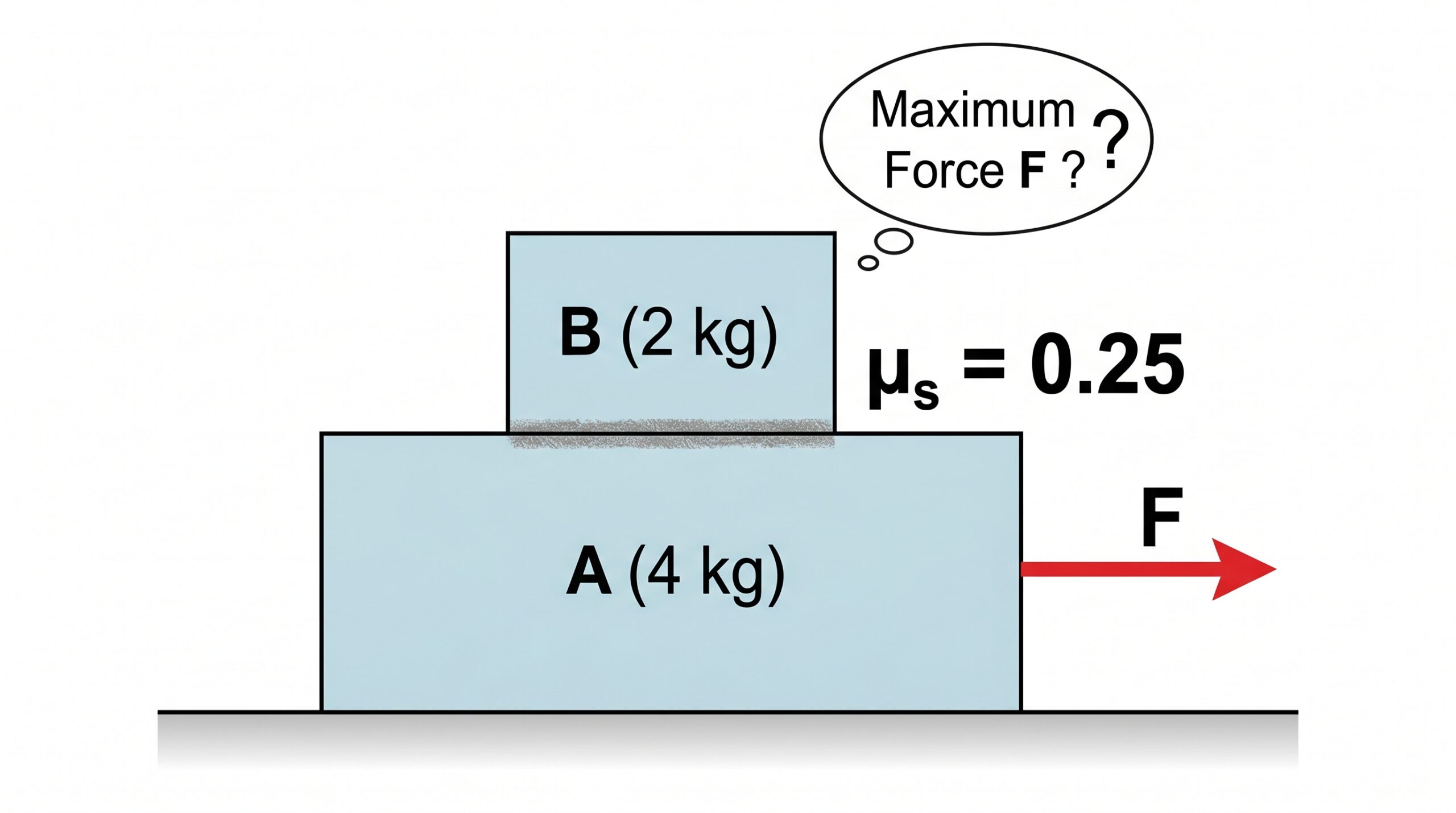
A block A (mass 4 kg) is placed on a smooth horizontal surface. Another block B (mass 2 kg) is placed on top of A. A horizontal force F is applied to block A as shown. The coefficient of static friction between the two blocks is μ = 0.25. Find the maximum value of force F such that both blocks move together without slipping.

Maximum Force such that both blocks move together

Complete Video Solution below

Maximum Force such that both blocks move together Without Slipping: Understanding the Real Physics

One of the most common friction problems in JEE Main, JEE Advanced, and NEET involves two blocks placed one above the other. A horizontal force is applied to the lower block, and students are asked to find the maximum force that can be applied so that both blocks move together without slipping.

At first glance, this may look like a standard formula-based problem. However, the real value of this question lies in the concepts it teaches.

In fact, many students solve such problems mechanically without understanding the actual role of friction. As a result, they often make mistakes when the problem is slightly modified.

Before jumping to equations, let us first understand the physics behind this situation.

The First Question: How Does the Upper Block Move?

Suppose a force is applied to the lower block.

The lower block is directly connected to the external force, so it is obvious why it starts moving.

But what about the upper block?

No force is directly applied to it.

So why should it move at all?

This is the most important question in the entire problem.

Before writing equations, always ask yourself:

What is the force responsible for accelerating the upper block?

Once you answer this question, the entire problem becomes much easier.

Many students immediately start looking for formulas.

A better approach is to first understand the physics.

Do not start with formulas. Start with physics.

The Hero of the Story: Static Friction

The upper block moves because of static friction.

Many students think friction only opposes motion.

This is not entirely true.

A more accurate statement is:

Friction opposes relative motion or the tendency of relative motion between two surfaces.

In this problem, the lower block tries to move forward. If there were no friction, the lower block would slide out from beneath the upper block.

Static friction prevents this from happening.

It pulls the upper block forward and allows both blocks to move together.

Therefore, static friction is not acting as an enemy here.

It is actually helping the upper block move.

This is a very important idea that students should remember.

Static Friction Is Smarter Than Most Students Think

Many students believe that static friction is always equal to μN.

This is one of the most common misconceptions in mechanics.

Static friction is not a fixed force.

It adjusts itself according to the requirement of the situation.

If a small friction force is needed, static friction provides a small force.

If a larger friction force is needed, static friction increases its value.

However, it cannot increase forever.

There is a maximum limit beyond which static friction cannot go.

As long as the required friction remains below this limit, the blocks continue to move together.

The moment the required friction exceeds this limit, slipping begins.

Understanding this single idea can solve a large number of friction problems.

Why Friction Direction Confuses Students

One of the most common mistakes in friction problems is assuming the wrong direction of friction.

Students often memorize rules instead of thinking physically.

The correct approach is simple.

Ask yourself:

If friction were absent, what would happen?

Without friction, the lower block would move forward while the upper block would tend to stay where it is because of inertia.

Therefore, relative to the lower block, the upper block would appear to move backward.

Static friction opposes this tendency.

As a result, friction acts forward on the upper block.

According to Newton’s Third Law, an equal and opposite friction force acts backward on the lower block.

The direction becomes obvious once you understand the physical situation.

A Common Mistake Students Make

Many students immediately draw friction opposite to the motion of the object.

This shortcut often creates confusion.

Remember:

Friction does not oppose motion. Friction opposes relative motion.

This small distinction can completely change the solution.

Whenever you are confused about friction direction, imagine the situation without friction.

The correct direction usually becomes obvious.

A small mistake here can spoil the entire problem.

As teachers often say:

A small mistake in friction direction can make the entire solution go wrong.

Moving Together Means No Slipping

The statement “both blocks move together” is extremely important.

It tells us that there is no relative motion between the two blocks.

Since there is no slipping, kinetic friction does not come into the picture.

Only static friction is acting.

Many students immediately use friction formulas without first identifying the type of friction involved.

This is dangerous.

Always determine whether slipping is occurring or not before choosing the friction model.

As long as the two blocks move together, static friction is responsible for maintaining the common motion.

Can Static Friction Do the Job?

Now we come to the central idea of the problem.

The upper block needs a certain force to accelerate along with the lower block.

That force is supplied by static friction.

However, static friction is not unlimited.

It has a maximum possible value.

As the applied force on the system increases, the acceleration of the system increases.

A larger acceleration means the upper block requires a larger friction force.

Initially, static friction can easily provide the required force.

But as the applied force keeps increasing, a stage is reached where the required friction becomes equal to the maximum friction available.

This is the limiting situation.

At this point, static friction is working at its highest possible value.

This condition determines the maximum force that can be applied while keeping both blocks together.

What Happens Beyond This Limit?

Suppose we increase the applied force even further.

Now the upper block requires more friction than static friction can provide.

But friction cannot exceed its maximum limit.

As a result, static friction fails to maintain common motion.

The upper block can no longer keep up with the lower block.

Relative motion begins.

Slipping starts.

The moment slipping starts, static friction disappears and kinetic friction takes over.

This is why the problem asks for the maximum force.

It is asking for the boundary between two situations:

  1. Both blocks move together.

  2. The upper block starts slipping.

Understanding this boundary is much more important than memorizing any formula.

Why This Problem Is More Important Than It Looks

At first glance, this appears to be a simple two-block friction problem.

However, the ideas used here appear again and again in mechanics.

The same concepts are used in:

  • Friction problems

  • Wedge problems

  • Pulley systems

  • Circular motion with friction

  • Advanced Newton’s Laws questions

The goal is not to remember an answer.

The goal is to understand how forces interact and how friction helps maintain common motion.

Once you understand the physics behind this question, many seemingly difficult problems become much easier.

Physics Is About Understanding, Not Memorization

Many students search for shortcuts and formulas.

However, formulas are only the final result of physical reasoning.

If you understand the role of friction, the direction of friction, and the condition for slipping, you can derive the result whenever required.

That is the real goal of learning physics.

The two-block friction problem teaches us something far more valuable than a numerical answer.

It teaches us how static friction helps two surfaces maintain common motion and how slipping begins when friction reaches its limit.

Once this concept becomes clear, many friction problems become surprisingly simple.

Remember:

Do not start with formulas. Start with physics.

When the physics is clear, the mathematics becomes easy.

Final Solution

Given:
m_A\;=\;4\;kg

m_B=2kg
\mu_s=0.25
Maximum static friction:

f_{max\;=\;\mu_s\;m_B\;g}

System acceleration at limiting condition:

a_{max\;=\;\mu_s\;\;g}
a_{max\;=\;0.25\times\;\;10}
a_{max}=\;2.5\;m/s^2

For the complete system:

Fmax=(mA+mB)amaxF_{max}=(m_A+m_B)a_{max} Fmax=6×2.5=15 NF_{max}=6\times2.5=15\,N

Answer: Fmax=15NF_{max}=15N

Author: Deep Aman Sir

Founder, PCM TUTORIALS | Physics Faculty for JEE, NEET & CBSE

Online Physics Classes

              Online Physics Classes by Mr. Deep Aman 

Welcome to the Online Physics Classes program by PCM TUTORIALS.
These classes are specially designed for students preparing for JEE Main, JEE Advanced, NEET, and CBSE Board examinations.

Physics is taught with a strong focus on:

  • Conceptual clarity
  • Advanced problem solving
  • Visualization and derivations
  • Numerical applications
  • Real understanding of Physics

Classes are conducted live by Mr. Deep Aman, who has been teaching competitive Physics since 2015. 

Mr. Deep Aman is the founder of PCM TUTORIALS. With over 10 years of experience in teaching Physics in offline classroom settings, he has now transitioned to the online platform to expand his reach and help a wider range of students.

His teaching approach focuses on deep conceptual clarity, problem-solving skills, and simplifying complex Physics topics for JEE, NEET, and board aspirants through a structured digital learning system.

Live Online Physics  Classes on Zoom

Interactive live classes are conducted regularly on Zoom where students can:

  • Learn concepts step-by-step
  • Ask doubts during class
  • Practice numerical problems
  • Understand derivations deeply
  • Improve problem-solving speed and accuracy
    •  

Features of Our Online Physics Classes

    • Live Zoom Sessions
    • Doubt Discussion
    • Topic-wise Assignments
    • Practice Questions
    • Conceptual Learning
    • Regular Tests
    • Personal Guidance


Who Can Join?

  • Class 11 Students
  • Class 12 Students
  • JEE Aspirants
  • NEET Aspirants
  • CBSE Students


Small Batch Personalized Learning

Each batch is either personalized or consists of a group of fewer than 5 students to ensure individual attention, better interaction, and strong conceptual understanding.

Know Your Tutor

To know your teacher, teaching methodology, dedication towards Physics, and conceptual style of teaching, visit our YouTube channel:

Deep Aman Online Physics

PhysicsEduMedia